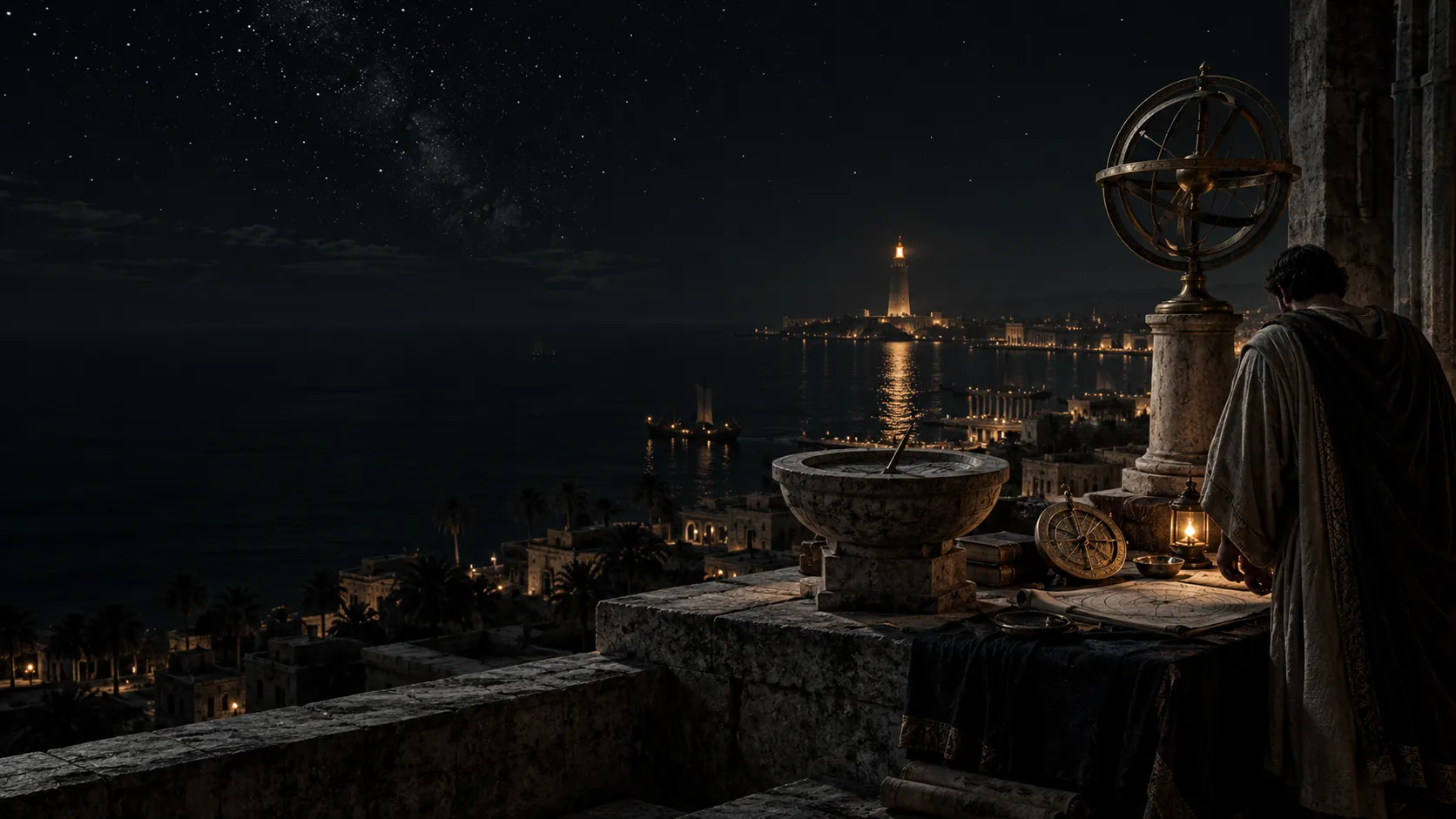
“There is an island in the surging sea, in front of Egypt; Pharos they call it.” (Homer, Odyssey 4.354–355)
Plutarch, writing some four centuries after the founding and citing Heracleides, tells that Homer spoke these lines to Alexander in a dream, and that Alexander built his city here (Alexander 26.5–7). A story.Legend: told storyHomer's dream
“There is an island in the surging sea, in front of Egypt; Pharos they call it.” (Homer, Odyssey 4.354–355)
Plutarch, writing some four centuries after the founding and citing Heracleides, tells that Homer spoke these lines to Alexander in a dream, and that Alexander built his city here (Alexander 26.5–7). A story.
A time portal
The Library of Alexandria
Its rooms have never been found. Its catalogue survives in pieces. Step through to watch the city build, burn and empty across nearly a thousand years, and to stand among the books it held. Everything here is marked: what is known, what is reconstructed, and what is only told.
Plate · Stand-inStand-in. An evocation, not a reconstruction. The Pharos is described as a tower of white stone in many storeys (Strabo 17.1.6); medieval writers give it tiers. This picture draws a single slender tower.
The city in time
Scroll, and the city changes under you. Every line on the plan is graded: solid where the position is known, dashed where it is conjectured; legends are never drawn.
The Founding
331–283 BCE
The founding: known Known: attested
The Mouseion's date: probable Known: probable
In 331 BCE Alexander has a city laid out on the limestone ridge between the sea and Lake Mareotis, opposite the island of Pharos. The sources disagree whether he did so before or after his journey to the oracle of Ammon at Siwa. Deinocrates of Rhodes plans the grid. Ptolemy, Alexander's general and king from 305/304, brings Alexander's body to Egypt. Probably late in Ptolemy's reign, with the Athenian Demetrius of Phalerum at his court, a shrine of the Muses with salaried scholars is founded in the palace quarter. No ancient source gives the year.
No witness of the founding survives. The narratives that do were written three centuries and more after it, and they disagree on whether Alexander laid out the city before or after his journey to the oracle of Ammon. The street grid itself is the one contemporary witness.
Before or after Siwa?No witness of the founding survives. The narratives that do were written three centuries and more after it, and they disagree on whether Alexander laid out the city before or after his journey to the oracle of Ammon. The street grid itself is the one contemporary witness.
Witness
Written
Reference
What it says
Readings
The event: 331 BCE
Ptolemy and AristobulusLost; known through a later writer
c. 300 BCE
Histories of Alexander (lost) lost Quoted by Arrian, Anabasis, preface 1–2.
Their accounts are lost; Arrian says he followed them.
—none
DiodorusNames it, no number
c. 60–30 BCE
Library of History 17.49–52
Has Alexander found the city on his way back from Siwa.
—none
VitruviusNames it, no number
c. 25 BCE
On Architecture 2 praef. 4
Names Deinocrates as the architect of the city.
—none
StraboNames it, no number
c. 20 BCE
Geography 17.1.6–10
Describes the city and its grid as he walked it; gives no order of founding and journey.
—none
Curtius RufusNames it, no number
1st century CE
History of Alexander 4.7–4.8.2
Has the founding after the visit to Siwa.
—none
PlutarchNames it, no number
c. 100 CE
Alexander 26.3–27.1
Tells Homer's dream and the barley meal, then the journey to Ammon: the founding first.
—none
ArrianNames it, no number
c. 130 CE
Anabasis 3.1.5–3.2.2
Puts the founding before the journey to Siwa, following Ptolemy and Aristobulus.
—none
Mahmoud el-FalakiExcavation
1866
Survey of the ancient streets 1866
Traces the ancient grid under the modern city.
—none
What we can say
The city's grid is its own evidence: it survives under the modern streets.
What we cannot say
The year the Mouseion or the Library was founded, or by which king. The earliest surviving narrative of the founding was written some 270 years after it, though Arrian drew on Ptolemy's own lost history.
Plutarch, citing Heracleides, tells that a grey-haired man stood beside Alexander in a dream and recited Homer's lines: "There is an island in the surging sea, in front of Egypt; Pharos they call it." Alexander rose, went to Pharos, and chose the ground for his city.
Told by Plutarch, citing Heracleides, c. 100–120 CE, some four centuries after the founding
What the evidence supports
Alexander founded the city in 331 BCE opposite the island of Pharos; every narrative says so. The dream is a story told to make the founding fated, and no earlier source has it.
Curtius, Plutarch and Arrian tell that the surveyors had no chalk and marked out the city's lines in barley meal; birds came down and ate it, and the seers said the city would feed many peoples.
Told by Curtius Rufus, Plutarch and Arrian, 1st–2nd century CE, some four centuries after the founding
What the evidence supports
The city's grid is real and survives under the modern streets. The omen is a story of the kind told of many foundations.
✶Demetrius as librarian, a told storyLegend: told story
Demetrius as librarian
The Letter of Aristeas makes Demetrius of Phalerum the head of Ptolemy II's library, with funds to collect all the books in the world, and has him report 200,000 rolls with 500,000 to come.
Told by The Letter of Aristeas, c. 150–100 BCE, more than a century after Demetrius
What the evidence supports
Demetrius was at the court of Ptolemy I. By Hermippus's account Ptolemy II had him held under guard in the countryside after Ptolemy I's death. No source independent of the Letter makes him the Library's head.
✶Aristotle taught the kings, a told storyLegend: told story
Aristotle taught the kings
Strabo says that Aristotle was the first we know of to collect books, and that he taught the kings in Egypt how to arrange a library.
Told by Strabo, c. 7 BCE–23 CE, some three centuries after Aristotle's death
What the evidence supports
Aristotle died in 322 BCE, before any Ptolemy was king. His school's ways may have reached Egypt through his pupils, Demetrius of Phalerum and Strato among them; that is an inference, not a record.
Proclus tells that when Ptolemy asked whether there was a shorter way to geometry than the Elements, Euclid answered that there is no royal road to geometry.
Told by Proclus, c. 450–485 CE, some seven centuries later
What the evidence supports
Euclid probably taught in Alexandria under Ptolemy I, as Proclus says. The retort floats: Stobaeus tells the same of Menaechmus and Alexander.
The size of the collection: no reliable figure Conjectured: our reconstruction
Drawing · Reconstruction Strabo names a walk, an exedra and a hall (17.1.8). No building has been identified; the forms are drawn after buildings elsewhere, and the arrangement is ours.
Under Ptolemy II the royal collection grows into what contemporaries and later writers thought the largest in the Greek world. Zenodotus probably makes the first critical edition of Homer in these years, and Tzetzes says the tragedies and comedies were sorted for editing. Callimachus of Cyrene compiles the Pinakes: 120 books listing Greek authors by class, with each work's opening words and length in lines. The Jewish community of the city translates the Torah into Greek. Manetho, a priest of Sebennytos, writes Egypt's history in Greek. A sceptic poet mocks the scholars the king feeds as birds in "the birdcage of the Muses".
Contemporaries knew the Mouseion and laughed at it. The stories of the collecting were written a century and more later, and the one eyewitness to the Mouseion names no library.
Who saw the Great Collection?Contemporaries knew the Mouseion and laughed at it. The stories of the collecting were written a century and more later, and the one eyewitness to the Mouseion names no library.
Witness
Written
Reference
What it says
Readings
The event: 283–246 BCE
HerodasNames it, no number
c. 270–250 BCE
Mimiambi 1.26–35
Lists the wonders of Egypt, the Mouseion among them.
—none
Timon of PhliusNames it, no number
c. 270–240 BCE
Silloi fr. 12 Diels Quoted by Athenaeus 1.22d.
Mocks the scholars fed in "the birdcage of the Muses".
—none
Letter of AristeasTeller of a legend
c. 150–100 BCE
Letter to Philocrates 9–11
Has Demetrius of Phalerum gather all the world's books for Ptolemy II: a charter story.
—none
VitruviusNames it, no number
c. 25 BCE
On Architecture 7 praef. 4–7
Tells of a poetry contest judged by Aristophanes from the library's cases.
—none
StraboSilent on it
c. 20 BCE
Geography 17.1.8
Describes the Mouseion; names no library.
—none
P.Oxy. X 1241Inscription or papyrus
2nd century CE
A papyrus handbook of learned lists col. ii
Lists royal tutors from Apollonius to Cydas; it never uses the word librarian.
—none
AthenaeusNames it, no number
c. 200 CE
Deipnosophists 1.3a–b
Says Ptolemy II bought Aristotle's books and others in Athens and Rhodes.
—none
The SudaNames it, no number
10th century CE
Lexicon κ 227; ζ 74
Gives Callimachus's Pinakes in 120 books, and Zenodotus as head of the libraries and first corrector of Homer.
—none
TzetzesNames it, no number
12th century CE
Prolegomena de comoedia Koster XIa I–II
Tells how the drama and epic were sorted for editing under Ptolemy II.
—none
What we can say
Contemporaries knew the Mouseion and laughed at it; its scholars' works survive in quantity.
What we cannot say
How many rolls it held, or whether the court had any part in the translation of the Torah.
✶Letters to every king, a told storyLegend: told story
Letters to every king
Epiphanius tells that the king wrote to every king and ruler on earth, asking them to send the works of their poets, historians, physicians and philosophers.
Told by Epiphanius, 392 CE, some six centuries after Ptolemy II
What the evidence supports
The ambition to hold the writings of every people is attested from the Letter of Aristeas on. The letters are a story; no such correspondence is known.
✶The seventy-two elders, a told storyLegend: told story
The seventy-two elders
The Letter of Aristeas tells that Demetrius of Phalerum urged Ptolemy II to have the Jewish Law translated for his library, and that seventy-two elders came from Jerusalem and finished the work in seventy-two days on the island of Pharos.
Told by The Letter of Aristeas, c. 150–100 BCE, about a century after the translation
What the evidence supports
The Torah was translated into Greek in Alexandria in the 3rd century BCE; its Greek is that of Ptolemaic Egypt. Whether the court had any part in it, or whether a copy was placed in the Library, is unknown.
✶Callimachus as chief librarian, a told storyLegend: told story
Callimachus as chief librarian
The Latin note called the Scholium Plautinum, drawn from Tzetzes, calls Callimachus the royal librarian. Modern books often make him the Library's chief.
Told by The Scholium Plautinum, a Latin note drawn from Tzetzes, 15th century CE, some seventeen centuries after Callimachus
What the evidence supports
Callimachus compiled the Pinakes, the Library's great catalogue. The papyrus list of the heads does not name him, and Tzetzes's Greek calls him a young man of the court; most scholars think he was never its head.
✶"Healing place of the soul", a told storyLegend: told story
"Healing place of the soul"
Diodorus says that over the sacred library in the tomb of Osymandyas at Thebes stood the words "healing place of the soul". Modern books often give them as the motto over the door of the Library of Alexandria.
Told by Diodorus of Sicily, of a library at Thebes, c. 60–30 BCE, a description of another library; moved to Alexandria by modern books
What the evidence supports
No ancient source puts these words at Alexandria. Diodorus gives them to a library at Thebes, in the Ramesseum, the temple he calls the tomb of Osymandyas.
The Serapeum's founding: excavated Known: excavated
The order of the librarians: disputed Known · Disputed: probable, disputed
Drawing · After Cleomedes The method as Cleomedes reports it (Caelestia 1.7). Not to scale.
Ptolemy III summons Eratosthenes of Cyrene to head the Library, and probably to tutor his son; Eratosthenes measures the Earth from the angle of the noon sun. On the hill of the Egyptian quarter the king builds a temple for Sarapis, and his foundation plaques have been dug up. Aristophanes of Byzantium writes a book correcting Callimachus's catalogue, and the text of Homer settles in Aristarchus's time. Four centuries later Galen tells how the king had every book on ships putting in at Alexandria copied and kept the originals.
Modern estimate: tens of thousands of rolls, perhaps more (Bagnall 2002; Casson 2001 and others accept larger collections). A catalogue of 120 rolls could hardly have listed hundreds of thousands of rolls (Bagnall 2002, 352–356). We can name 185 works. The rest is behind the closed doors.
How many rolls?Modern estimate: tens of thousands of rolls, perhaps more (Bagnall 2002; Casson 2001 and others accept larger collections). A catalogue of 120 rolls could hardly have listed hundreds of thousands of rolls (Bagnall 2002, 352–356). We can name 185 works. The rest is behind the closed doors.
Witness
Written
Reference
What it says
Readings
The event: The collection, as its tellers counted it
The Letter of AristeasGives a number
c. 150 BCE
Letter of Aristeas 9–11
Demetrius of Phalerum reports over 200,000 books in the king's library and hopes soon for 500,000.
200,000
SenecaGives a number
c. 50–62 CE
On Tranquillity of Mind 9.5 Quoted by Livy, whose lost history Seneca cites.
Forty thousand books burned at Alexandria; he quotes Livy's praise of the library and rejects it.
40,000; a common modern emendation of the manuscripts' 40,000
Aulus GelliusGives a number
c. 170s CE
Attic Nights 7.17.3
Nearly 700,000 volumes burned in the Alexandrian war, set alight by auxiliary soldiers.
700,000; the reading of some manuscripts
Ammianus MarcellinusGives a number
c. 390 CE
History 22.16.13
Seven hundred thousand books burned in the war under Caesar.
700,000
EpiphaniusGives a number
392 CE
On Weights and Measures 9
54,800 books; which library he counts is to be checked against chapter 11's daughter library.
54,800
OrosiusGives a number
c. 417 CE
Histories against the Pagans 6.15.31
Four hundred thousand books burned under Caesar.
400,000; the reading of some manuscripts
Isidore of SevilleGives a number
7th century CE
Etymologies 6.3.5
Seventy thousand books in the library of Ptolemy.
70,000
John TzetzesGives a number
12th century CE
Prolegomena on Comedy the outer library
42,800 books in the library outside the palace.
42,800
John TzetzesGives a number
12th century CE
Prolegomena on Comedy the palace library, 'mixed' rolls
400,000 'mixed' rolls in the palace library.
400,000
John TzetzesGives a number
12th century CE
Prolegomena on Comedy the palace library, 'unmixed' rolls
90,000 'unmixed' rolls in the palace library.
90,000
What we can say
Ptolemy III founded the Serapeum: his plaques survive.
What we cannot say
Who headed the Library in what order: the papyrus list and the Suda disagree (Murray 2012).
✶Books from the ships, a told storyLegend: told story
Books from the ships
Galen tells that Ptolemy III had every book found on ships putting in at Alexandria brought to him and copied, gave the owners the copies, and kept the originals labelled "from the ships".
Told by Galen, c. 175–199 CE, some four centuries after Ptolemy III
What the evidence supports
One late source, told to explain a label on a copy of the Hippocratic Epidemics. The label may be real; the policy is Galen's story.
✶Fifteen talents for the tragedians, a told storyLegend: told story
Fifteen talents for the tragedians
Galen tells in the same passage that Ptolemy III borrowed Athens's official copies of Aeschylus, Sophocles and Euripides against a pledge of fifteen talents, kept the originals, sent back fine new copies, and let the Athenians keep the silver.
Told by Galen, c. 175–199 CE, some four centuries after Ptolemy III
What the evidence supports
Athens did keep official texts of the three tragedians, by a law of Lycurgus in the 330s BCE. That they went to Alexandria rests on Galen alone.
✶The plagiarists exposed, a told storyLegend: told story
The plagiarists exposed
Vitruvius tells that at a poetry contest Aristophanes of Byzantium, one of the judges, named the poets who had stolen their verses and fetched the originals from the library's cases from memory.
Told by Vitruvius, c. 30–20 BCE, about a century and a half after Aristophanes
What the evidence supports
Aristophanes headed the Library and was famed for his learning. The contest is an anecdote found in Vitruvius alone.
#34 · 36:14Nearest the show comes: Telestic art and ensouling statues, episode 34, at 36 minutes 14 secondsTelestic art and ensouled statues. The Serapeum's cult statue is the most famous ensouled image of the city, and its smashing in 391/392 is the scene Rufinus tells; the chapter is about the art in general, not this statue.Known: attested
The show has not yet spoken of Eratosthenes or the Serapeum.
What burned: disputed Known · Disputed: probable, disputed
In 145 BCE Ptolemy VIII drives out the scholars who had backed his rivals: Aristarchus dies in Cyprus and a soldier, Cydas "of the spearmen", is put in charge. Scholarship goes on: Didymus "Bronze-guts" writes thousands of books of commentary, which needs a great library to hand. Late in 48 BCE Caesar, besieged in the palace quarter, burns the Egyptian fleet and the fire spreads to the docks. Books burn somewhere along the quays. How many, and whose, the witnesses do not agree, and the nearest of them say nothing of books. In 30 BCE Egypt becomes Roman.
The nearest witnesses say nothing of books, and the numbers grow with distance. Rival manuscript readings hang from dashed lines.
What burned in 48 BCE?The nearest witnesses say nothing of books, and the numbers grow with distance. Rival manuscript readings hang from dashed lines.
Witness
Written
Reference
What it says
Readings
The event: late 48 BCE
AnonymousSilent on it
c. 46–41 BCE
Alexandrian War 1–33
Tells the war in the city; says nothing of books burned.
—none
CaesarSilent on it
c. 45 BCE
Civil War 3.111
Burns the Egyptian fleet; says nothing of books.
—none
LivyLost; known through a later writer
c. 27 BCE–17 CE
History of Rome (lost book) lost Quoted by Seneca, On Tranquillity of Mind 9.5.
His account is lost; Seneca quotes its number.
—none
StraboSilent on it
c. 20 BCE
Geography 17.1.8
Describes the Mouseion at work; says nothing of a fire.
—none
SenecaGives a number
c. 50–62 CE
On Tranquillity of Mind 9.5
Forty thousand books burned at Alexandria, citing Livy.
40,000; often emended to 400,000
LucanSilent on it
c. 61–65 CE
Civil War 10.486–505
The fire takes buildings by the sea; says nothing of books.
—none
PlutarchNames it, no number
c. 100 CE
Caesar 49.6
The fire spread from the dockyards and destroyed the great library.
—none
Aulus GelliusGives a number
c. 170–179 CE
Attic Nights 7.17.3
Nearly 700,000 rolls burned, by chance, by auxiliary soldiers.
700,000; some manuscripts read 70,000
Cassius DioNames it, no number
c. 220–229 CE
Roman History 42.38.2
The fire burned the dockyards and storehouses of grain and of books.
—none
Ammianus MarcellinusGives a number
c. 390 CE
History 22.16.13
700,000 rolls burned in the Alexandrian war under Caesar.
700,000
OrosiusGives a number
417 CE
Histories against the Pagans 6.15.31
400,000 books burned, stored by chance in buildings near the harbour.
400,000; some manuscripts read 40,000
What we can say
A fire in the harbour burned books, probably in storage near the docks (Bagnall 2002; Hatzimichali 2013).
What we cannot say
How many burned, or that the Library ended: twenty years later Strabo describes the Mouseion at work.
✶"Caesar burned the Library", a told storyLegend: told story
"Caesar burned the Library"
Plutarch writes that the fire Caesar set to the ships spread from the dockyards and destroyed the great library.
Told by Plutarch, c. 100–120 CE, some one hundred and fifty years after the fire
What the evidence supports
A fire in 48 BCE burned books, probably in storehouses near the docks. Caesar and the nearest witnesses say nothing of books, and twenty years later Strabo found the Mouseion at work.
Calvisius, accusing Antony in Rome in 32 BCE, said that he had given Cleopatra the libraries of Pergamon, 200,000 single-roll books. Plutarch adds that most of Calvisius's charges were thought to be lies.
Told by Calvisius, as Plutarch reports, 32 BCE, a charge made at the time, in Rome
What the evidence supports
A political charge that Plutarch himself doubts. Nothing shows that Pergamon's books came to Alexandria, or that they replaced anything lost in 48 BCE.
Aulus Gellius writes that nearly 700,000 rolls were burned in the Alexandrian war, by chance, by auxiliary soldiers; Ammianus repeats the figure about 390.
Told by Aulus Gellius, c. 170–179 CE, some two hundred and twenty years after the fire
What the evidence supports
No ancient source gives a reliable figure, and the manuscripts disagree on this one: some read 70,000. A catalogue of 120 rolls could hardly have listed hundreds of thousands. A modern estimate is tens of thousands of rolls, perhaps more.
Where the Hermetica were written: conjectured Conjectured
Plate · Stand-inStand-in. An evocation, not a reconstruction. The Pharos is described as a tower of white stone in many storeys (Strabo 17.1.6); medieval writers give it tiers. This picture draws a single slender tower.
Strabo, living in Alexandria in the 20s BCE, writes the only eyewitness description of the Mouseion: a covered walk, an exedra with seats, a great hall where the learned men eat together, a priest once named by the kings and now by Caesar. He never mentions the Library. The emperors keep the institution: Claudius adds a wing, Domitian sends copyists, Hadrian debates with its professors in 130. In the same city Philo reads Moses as a Platonist, the Gnostic teachers build their systems, Ptolemy writes the Almagest, Clement and Origen teach, and Plotinus finds Ammonius Saccas. The Greek Hermetica take shape in Roman Egypt; Alexandria is likely but unproven.
The best-witnessed age of the Mouseion: an eyewitness, two inscriptions and a run of writers who knew it as a working institution under imperial appointment.
Who saw the Mouseion under Rome?The best-witnessed age of the Mouseion: an eyewitness, two inscriptions and a run of writers who knew it as a working institution under imperial appointment.
Witness
Written
Reference
What it says
Readings
The event: 30 BCE–272 CE
StraboNames it, no number
c. 20 BCE
Geography 17.1.8
A walk, an exedra, a hall where the scholars dine together; a priest named by Caesar.
—none
PhiloNames it, no number
c. 40 CE
Embassy to Gaius 151
Names libraries among the porticoes of the Caesareum.
—none
I.Ephesos 3042Inscription or papyrus
c. 41–100 CE
Inscription honouring Ti. Claudius Balbillus 3042
Lists a post over the Alexandrian libraries; the title is partly restored.
—none
IG XIV 1085Inscription or papyrus
117–138 CE
Inscription of L. Julius Vestinus 1085
Vestinus, under Hadrian, head of the Mouseion and of the libraries in Rome.
—none
SuetoniusNames it, no number
c. 120 CE
Lives of the Caesars Claudius 42.2; Domitian 20
Claudius adds a new Mouseion; Domitian sends copyists to Alexandria.
—none
AthenaeusNames it, no number
c. 200 CE
Deipnosophists 15.677d–f
Hadrian makes the poet Pancrates a member.
—none
PhilostratusNames it, no number
c. 230 CE
Lives of the Sophists 1.22.3
Calls the Mouseion an Egyptian table that summons the famous men of every land.
—none
Cassius DioNames it, no number
c. 230 CE
Roman History 78[77].7.3
Caracalla abolishes the Aristotelians' common meals in 215.
—none
Historia AugustaNames it, no number
c. 380–400 CE
Hadrian 20.2
Hadrian questions the professors of the Mouseion. Late; often unreliable.
—none
What we can say
The Mouseion was a working institution under imperial appointment well into the 3rd century.
What we cannot say
That any of these teachers worked in the Mouseion; membership is attested for very few. The safe phrase is "taught in Roman Alexandria".
✶Hermes the ancient sage, a told storyLegend: told story
Hermes the ancient sage
Lactantius tells that Hermes Trismegistus lived long before Plato and Pythagoras and foresaw the truth of the Christian faith. Renaissance readers set him in the age of Moses.
Told by Lactantius, c. 303–311 CE, two centuries or more after the Hermetica were written
What the evidence supports
The Greek Hermetica were written in Roman Egypt, probably between about 100 and 300 CE. Isaac Casaubon showed in 1614 that they belong to the Christian era.
✶Plato learned from Hermes, a told storyLegend: told story
Plato learned from Hermes
Marsilio Ficino, prefacing his Latin Hermetica, sets out a chain of ancient theologians from Hermes Trismegistus through Orpheus and Pythagoras to Plato, so that Plato's wisdom descends from Hermes.
Told by Marsilio Ficino, 1471, some eighteen centuries after Plato
What the evidence supports
The Hermetic treatises are later than Plato and draw on Platonism, not the other way about. The show's hosts make this correction on air, in episode 21.
✶The Scythian sage, a told storyLegend: told story
The Scythian sage
The Acts of Archelaus, a 4th-century polemic against the Manichaeans, tells of Scythianus, a teacher from Scythia who lived in Egypt and was a forerunner of Mani. Modern retellings sometimes call Ammonius Saccas a Scythian sage.
Told by Hegemonius, Acts of Archelaus, c. 330–350 CE, a century after Ammonius
What the evidence supports
No ancient source calls Ammonius Saccas a Scythian. Porphyry's Life of Plotinus, the main source for him, does not.
Books destroyed: no source says so Conjectured: our reconstruction
In 272, in the war that recovers Egypt from Palmyra, the palace quarter where the Mouseion stood is ruined. If the palace library still existed, this is its likeliest end, though no ancient writer says so. Diocletian takes the city after a siege in 298, and a late source says he burned the Egyptian books on making gold. Theon, "the man of the Mouseion", observes eclipses in 364. On the hill of the Egyptian quarter the Serapeum, rebuilt in granite and climbed by more than a hundred steps, still stands. In 391 or 392, after Theodosius forbids sacrifice, Bishop Theophilus's campaign ends with the colossal statue broken and the temple pulled down. No account of the destruction mentions books.
Every account of 391/392 is silent on books. Ammianus, writing just before, already speaks of the temple's libraries in the past tense.
Did books burn at the Serapeum?Every account of 391/392 is silent on books. Ammianus, writing just before, already speaks of the temple's libraries in the past tense.
Witness
Written
Reference
What it says
Readings
AphthoniusNames it, no number
c. 350–400 CE
Progymnasmata 12
Rooms in the colonnades held books, open to those who wish to study.
—none
Ammianus MarcellinusNames it, no number
c. 390 CE
History 22.16.12
There were libraries in the Serapeum: the past tense.
—none
Theodosian CodeSilent on it
16 June 391 CE
Law to the prefect of Egypt 16.10.11
Forbids sacrifice and access to the temples; says nothing of books.
—none
The event: 391 or 392 CE
EpiphaniusNames it, no number
392 CE
On Weights and Measures 11
A second library in the Serapeum, called the daughter of the first.
—none
EunapiusSilent on it
c. 400 CE
Lives of the Sophists 472
Hostile: the monks made war on stones. Says nothing of books.
—none
RufinusSilent on it
c. 402 CE
Church History 11.22–30
Describes the temple he saw and its destruction; says nothing of books.
—none
OrosiusNames it, no number
c. 417 CE
Histories against the Pagans 6.15.32
Saw empty book-chests in temples, emptied in his own time; names no temple.
—none
Socrates ScholasticusSilent on it
c. 440 CE
Church History 5.16–17
Tells the destruction; says nothing of books.
—none
SozomenSilent on it
c. 445 CE
Church History 7.15
Tells the siege of the temple and Olympius; says nothing of books.
—none
TheodoretSilent on it
c. 449 CE
Church History 5.22
Tells the breaking of the statue; says nothing of books.
—none
Alan RoweExcavation
1943–1945
Excavation of the Serapeum Rowe 1946
Finds Ptolemy III's foundation plaques; no trace of a library's rooms is identified.
—none
What we can say
The temple was destroyed. A library had stood in its colonnades earlier (Tertullian, Epiphanius, Aphthonius).
What we cannot say
Whether any books remained there in 391. "Theophilus burned the Library" appears in no source.
✶"Theophilus burned the Library", a told storyLegend: told story
"Theophilus burned the Library"
Gibbon writes that when the Serapeum fell the valuable library of Alexandria was pillaged or destroyed, and reads Orosius's empty shelves as its remains. Later books say Bishop Theophilus burned the Library.
Told by Edward Gibbon, 1781, almost fourteen centuries after the Serapeum fell
What the evidence supports
The temple was destroyed in 391 or 392. No account of the destruction mentions books, and Ammianus, just before, already speaks of its libraries in the past tense.
✶Books in the galleries, a told storyLegend: told story
Books in the galleries
Modern guides to the Serapeum's hill tell visitors that the daughter library was kept in the rock-cut galleries beneath the temple.
Told by Modern guides to the site, 20th century CE, some fifteen centuries after the temple fell
What the evidence supports
The galleries are excavated and probably served the cult. No ancient source puts books in them; Aphthonius places the book-rooms in the colonnades above.
✶The statue from Sinope, a told storyLegend: told story
The statue from Sinope
Tacitus tells that a young man appeared to Ptolemy I in a dream and bade him fetch his statue from Pontus; after three years the god's image was brought from Sinope, and a temple raised for it. Plutarch tells it too.
Told by Tacitus, c. 105–110 CE, some four centuries after Ptolemy I
What the evidence supports
The cult of Sarapis was promoted by the first Ptolemies. The temple on the hill was built by Ptolemy III, whose foundation plaques have been dug up.
#34 · 36:14Nearest the show comes: Telestic art and ensouling statues, episode 34, at 36 minutes 14 secondsTelestic art and ensouled statues. The Serapeum's cult statue is the most famous ensouled image of the city, and its smashing in 391/392 is the scene Rufinus tells; the chapter is about the art in general, not this statue.Known: attested
A link to the Library: no ancient source Conjectured: our reconstruction
The caliph's order: legend Legend: told story
Hypatia, Theon's daughter, revises her father's work on Ptolemy and teaches Plato to the city's elite; her pupil Synesius writes to her for advice and instruments. In March 415, in the feud between the prefect Orestes and Bishop Cyril, a Christian mob kills her. No ancient source connects her with the Library. Her death does not end Alexandrian philosophy: Proclus studies here some ten years later, and Hermias, Ammonius, Olympiodorus, John Philoponus and Stephanus teach Plato and Aristotle for two centuries more. In November 641 the city surrenders by treaty; in September 642 the garrison sails. The story that the caliph ordered the books burned is first written down about 1200.
The ancient witnesses tell who she was and how she died, and none of them connects her with a library. The tellers who did came more than thirteen centuries later.
Hypatia and the LibraryThe ancient witnesses tell who she was and how she died, and none of them connects her with a library. The tellers who did came more than thirteen centuries later.
Witness
Written
Reference
What it says
Readings
SynesiusNames it, no number
c. 395–413 CE
Letters 10, 15, 16, 46, 81, 124, 154
Her pupil writes to her as teacher, for advice and for instruments.
—none
The event: March 415 CE
PhilostorgiusNames it, no number
c. 425–433 CE
Church History 8.9
Says she was killed by the party of the homoousians.
—none
Socrates ScholasticusNames it, no number
c. 440 CE
Church History 7.13–15
The fullest and nearest account: her teaching, the feud of Orestes and Cyril, the mob.
—none
DamasciusNames it, no number
c. 520–529 CE
Philosophical History fr. 43 Athanassiadi Quoted by Suda υ 166.
A pagan philosopher's account, preserved in the Suda.
—none
John of NikiuNames it, no number
c. 680–700 CE
Chronicle 84.87–103
Hostile: calls her a sorceress who beguiled the prefect.
—none
John TolandTeller of a legend
1720
Hypatia 1720
Makes her a learned martyr torn apart by the clergy.
—none
VoltaireTeller of a legend
from 1736
Essays and the Dictionnaire philosophique from 1736
Retells her death as a crime of fanaticism.
—none
Edward GibbonTeller of a legend
1788
Decline and Fall, ch. 47 1788
Shapes the modern story of her death.
—none
Charles KingsleyTeller of a legend
1853
Hypatia 1853
A novel of her last years.
—none
Carl SaganTeller of a legend
1980
Cosmos 1980
Joins her death to the end of the Library.
—none
Alejandro AmenábarTeller of a legend
2009
Agora 2009
A film that puts her at the sack of the Serapeum.
—none
Who tells of the caliph's order?
The witness nearest the conquest is detailed, hostile to the conquerors, and silent on books. The story appears some 550 years later and travels: Ibn Khaldun tells the same exchange of Persian books.
Who tells of the caliph's order?The witness nearest the conquest is detailed, hostile to the conquerors, and silent on books. The story appears some 550 years later and travels: Ibn Khaldun tells the same exchange of Persian books.
Witness
Written
Reference
What it says
Readings
The event: 641–642 CE
John of NikiuSilent on it
c. 680–700 CE
Chronicle 120
Tells the conquest in detail and with hostility; says nothing of books.
—none
‘Abd al-Latif al-BaghdadiTeller of a legend
c. 1200 CE
Account of Egypt c. 1200
Mentions in passing the library that ‘Amr burned with ‘Umar's permission.
—none
Ibn al-QiftiTeller of a legend
before 1248 CE
History of Learned Men Yahya al-Nahwi
The full story: John the Grammarian, the caliph's reply, six months of fuel for the baths.
—none
Bar HebraeusTeller of a legend
before 1286 CE
Abridged History of the Dynasties before 1286
Retells the story; Pococke's Latin of 1663 brings it to Europe.
—none
Ibn KhaldunTeller of a legend
1377 CE
Muqaddimah ch. 6
Tells the same exchange of the books of the Persians.
—none
Edward GibbonRefutes the story
1788
Decline and Fall, ch. 51 ch. 51
Rejects the story.
—none
Alfred J. ButlerRefutes the story
1902
The Arab Conquest of Egypt Butler 1902
Calls the story a fable.
—none
Bernard LewisRefutes the story
1990–2008
The Vanished Library; Anatomy of a Myth Lewis 1990, 2008
Traces the story to the age of Saladin.
—none
What we can say
Who she was, what she taught, when and how she died, and in whose quarrel; that the schools taught on.
What we cannot say
That she was a librarian or died for books; that any ancient library still existed in 642.
✶Hypatia, the last librarian, a told storyLegend: told story
Hypatia, the last librarian
Carl Sagan's Cosmos ends its account of the Library's destruction with Hypatia's death, and so joins the two; later tellers make her its last librarian. Cosmos is the latest date for the link; who first made it is still to be dated from Watts 2017.
Told by Carl Sagan, Cosmos, 1980, more than fifteen centuries after her death
What the evidence supports
No ancient source supports it. Hypatia taught mathematics and Platonism in Alexandria and was killed by a Christian mob in March 415; no ancient source connects her with the Library or with any library, and the Serapeum had fallen more than twenty years before.
✶The end of ancient science, a told storyLegend: told story
The end of ancient science
John Toland's Hypatia (1720) makes her a most learned and virtuous woman torn to pieces by the clergy of Alexandria. Voltaire and Gibbon follow him, and later tellers make her death the end of ancient science.
Told by John Toland, Hypatia, 1720, some thirteen centuries after her death
What the evidence supports
Her murder is attested; it was part of a feud between the prefect and the bishop. The schools of Alexandria went on teaching Plato, Aristotle and mathematics for two centuries after her.
✶The caliph's order, a told storyLegend: told story
The caliph's order
‘Abd al-Latif al-Baghdadi, writing about 1200, mentions in passing the library which ‘Amr burned with ‘Umar's permission. Ibn al-Qifti, a generation later, tells the whole story.
Told by ‘Abd al-Latif al-Baghdadi, c. 1200 CE, some 550 years after the conquest
What the evidence supports
No ancient source supports it. John of Nikiu, who wrote within a lifetime of the conquest and was hostile to the conquerors, says nothing of books burned; the story is unknown before about 1200, and no ancient library is known to have stood in 642.
✶Four thousand baths, a told storyLegend: told story
Four thousand baths
Ibn al-Qifti tells that John the Grammarian asked ‘Amr for the books of wisdom; the caliph replied that if they agreed with the Book of God they were unnecessary and if they disagreed undesirable, and the books fed the fires of the city's four thousand baths for six months.
Told by Ibn al-Qifti, before 1248 CE, some six centuries after the conquest
What the evidence supports
John Philoponus, the Grammarian, had died some seventy years before the conquest. Ibn Khaldun tells the same exchange of the books of the Persians: a travelling tale.
The Library did not burn once. It thinned over six centuries: a purge, a fire at the docks, emperors who stopped paying, a ruined palace quarter, a demolished temple. Beneath all of it ran the slow decay of papyrus, which lasts a century or two unless it is copied again. What burned, in the end, were stories, and each of them has a date and a teller. Under the eastern harbour lie the drowned stones of the palace quarter. On the shore a new library, opened in 2002, faces the sea: a homage, not a reconstruction.
What reached us: the catalogue's fragments, the works copied onward, the stones under the harbour and the plaques of the Serapeum.
What we cannot say
Where the Library stood, how many rolls it held, or the year it ceased to be a library.
Told stories
✶The hall you may have pictured, a told storyLegend: told story
The hall you may have pictured
Engravers of the 19th century drew the Library as a soaring hall with galleries of shelves and scholars in togas; Carl Sagan's Cosmos (1980) and the film Agora (2009) built it again.
Told by Engravers of the 19th century, then Cosmos and Agora, 19th century CE, more than two thousand years after the Library
What the evidence supports
No building of the Library has been found or described. Ancient book-rooms were rooms with cupboards along the walls, as at Pergamon and Ephesus, and rolls lay in pigeonholes.
✶The name under the plaster, a told storyLegend: told story
The name under the plaster
Lucian tells that the architect of the Pharos carved his own name in the stone, covered it with plaster and wrote the king's name on the plaster, so that when it fell away his name would stand for ever.
Told by Lucian, c. 160–170 CE, some four and a half centuries after the tower
What the evidence supports
Strabo and Posidippus say Sostratus of Cnidus dedicated the tower. The trick with the plaster is Lucian's anecdote, told to make a point about writing history.
✶"A wonder of the world", a told storyLegend: told story
"A wonder of the world"
Late antique lists of the seven wonders, Gregory of Tours's among them, set the Pharos in the place the walls of Babylon had held.
Told by Late antique lists of the seven wonders, 6th century CE, some eight centuries after the tower
What the evidence supports
The tower was real and famous: Strabo, Pliny and Posidippus describe it. The canon of seven wonders was a literary list that changed over time, and the Pharos joined it late.
2 doorways into the show, listed on the records named above.
Listen
Our device: The show's conversations, seated in Strabo's ‘exedra with seats’ (17.1.8).
I
Ammonius Saccas & Origins of Neoplatonism
Episode 22 · from 0:00 · 1 min · transcript
II
Plotinus, Eastern Philosophy & Alexandria
Episode 22 · from 0:48 · 1 min · transcript
III
Hermetic Texts & Pseudonymous Authorship
Episode 21 · from 50:55 · 1 min · transcript
IV
Egypt, Greece & the Birth of Hermeticism
Episode 21 · from 1:03:12 · 1 min · transcript
In the conversation, at 1:03:12: "Hermetic philosophy was informed by Plato."
V
Alexandria as Esoteric Crossroads
Episode 17 · from 47:57 · 1 min · transcript
Correction: the Nag Hammadi codices were found some 600 km south, in Upper Egypt.
VI
Hellenistic Roots of Western Esotericism
Episode · from 1:02:15 · 4 min · transcript
VII
Iamblichus, Theurgy & On the Mysteries
Episode 22 · from 41:09 · 3 min · transcript
Iamblichus is not Alexandrian: no source places him at work in the city.
Told stories
Four stories about the Library are often told as fact. No ancient source supports them; each is a story with a teller and a date.
✶"Healing place of the soul", a told storyLegend: told story
"Healing place of the soul"
Diodorus says that over the sacred library in the tomb of Osymandyas at Thebes stood the words "healing place of the soul". Modern books often give them as the motto over the door of the Library of Alexandria.
Told by Diodorus of Sicily, of a library at Thebes, c. 60–30 BCE, a description of another library; moved to Alexandria by modern books
What the evidence supports
No ancient source puts these words at Alexandria. Diodorus gives them to a library at Thebes, in the Ramesseum, the temple he calls the tomb of Osymandyas.
Aulus Gellius writes that nearly 700,000 rolls were burned in the Alexandrian war, by chance, by auxiliary soldiers; Ammianus repeats the figure about 390.
Told by Aulus Gellius, c. 170–179 CE, some two hundred and twenty years after the fire
What the evidence supports
No ancient source gives a reliable figure, and the manuscripts disagree on this one: some read 70,000. A catalogue of 120 rolls could hardly have listed hundreds of thousands. A modern estimate is tens of thousands of rolls, perhaps more.
Sources (3)
Aulus Gellius, Attic Nights 7.17.3
Ammianus Marcellinus 22.16.13
R. S. Bagnall, "Alexandria: Library of Dreams", Proceedings of the American Philosophical Society 146.4 (2002) 348–362 352–356
✶The caliph's order, a told storyLegend: told story
The caliph's order
‘Abd al-Latif al-Baghdadi, writing about 1200, mentions in passing the library which ‘Amr burned with ‘Umar's permission. Ibn al-Qifti, a generation later, tells the whole story.
Told by ‘Abd al-Latif al-Baghdadi, c. 1200 CE, some 550 years after the conquest
What the evidence supports
No ancient source supports it. John of Nikiu, who wrote within a lifetime of the conquest and was hostile to the conquerors, says nothing of books burned; the story is unknown before about 1200, and no ancient library is known to have stood in 642.
Sources (5)
‘Abd al-Latif al-Baghdadi, Account of Egypt c. 1200
John of Nikiu, Chronicle 120
B. Lewis, "The Vanished Library", letter in The New York Review of Books, 27 September 1990
B. Lewis, "The Arab Destruction of the Library of Alexandria: Anatomy of a Myth", in El-Abbadi and Fathallah (eds.), What Happened to the Ancient Library of Alexandria? (Leiden, 2008) 213–217
✶Hypatia, the last librarian, a told storyLegend: told story
Hypatia, the last librarian
Carl Sagan's Cosmos ends its account of the Library's destruction with Hypatia's death, and so joins the two; later tellers make her its last librarian. Cosmos is the latest date for the link; who first made it is still to be dated from Watts 2017.
Told by Carl Sagan, Cosmos, 1980, more than fifteen centuries after her death
What the evidence supports
No ancient source supports it. Hypatia taught mathematics and Platonism in Alexandria and was killed by a Christian mob in March 415; no ancient source connects her with the Library or with any library, and the Serapeum had fallen more than twenty years before.
Sources (3)
Socrates Scholasticus, Church History 7.13–15
E. J. Watts, Hypatia: The Life and Legend of an Ancient Philosopher (New York: Oxford University Press, 2017)
M. Dzielska, Hypatia of Alexandria (Cambridge, MA: Harvard University Press, 1995)
Everything here carries one of three words: Known, Conjectured or Legend. Each is a shape as well as a word, so none is told by colour alone.
Known · ExcavatedFound in the ground or on the seabed, and published.
Known · AttestedAn ancient source says so, and we name it.
Known · ProbableInferred from the evidence by most scholars; written “probably” or “c.”.
Conjectured · After an analogy: PergamonShown after a building elsewhere, named in a cartouche. Alexandria's own form is unknown.
Conjectured · Our reconstructionOur reconstruction, or a named scholar's proposal, said so in words.
Legend · Told storyA later story, told in its teller's voice with the date of the telling, and never drawn as a building.
DisputedThe seal split by a hairline: the sources disagree, and both accounts are given, each named.
DoubtedA split lozenge: the attribution is doubted, or the name is a pseudonym.
Lines
Excavated: solid, heavier, with hatching and the “Excavated” stamp.
Attested: a solid line.
Probable: a solid line, fainter.
After an analogy: dashed, with its cartouche.
Our reconstruction: faint construction lines, never fully inked.
Legend: rose dots, used only to frame a told story or mark a teller.
On the city plan a place is drawn solid where its position is known and dashed, with an italic name and “?”, where it is conjectured. Legends are never drawn.
The cartouche
after PergamonPlate · EvocationDrawing · Reconstruction
It says what a drawing leans on, or what kind of picture stands beside it.
Plates and drawings
Plates show places and things; drawings show rooms. A painted plate shows what is attested, excavated or plainly atmospheric, or a still life of attested objects. Every room nobody has found is drawn in line, with its grades. No plate shows a legend. Every plate carries a note saying what it claims.
The wall: one property, one channel
Survival
What lies in the hole at Now: three discs for whole; two and a dashed third for in large part; a disc and a small book-block for only in translation; a broken disc and a scrap for fragments; nothing, with the tag still hanging, for lost.
Where it lies
In a cupboard; on the table of the city, written or translated in Alexandria; or on the ledge, from Egypt or a witness to the city.
Class evidence
The cornice lettering: solid gold-bright for attested, a half lozenge for attested indirectly, plain gold for inferred, outline letters for conjecture.
Placement basis
The tag's edge at reading size: double gold for attested, single brass for inferred, dashed for by analogy.
In Alexandria?
The seal on the tag at reading size.
The show speaks of it
The cord: gold for the work or its author, brass for its current, none where the show is silent.
Told story
A rose star, and the story on the back of the tag.
Doubt
A split lozenge on the card.
Age
Present; future, as a dashed outline with its date; or ghost, as a stipple, where it is unknown whether the roll was still in the city.
Lamp or search
Lit, with a gold-bright outline; second tier, dashed; dimmed to 30%.
What no one can name
The closed door.
At overview size only survival, the cord and the star are drawn. An empty hole means a lost work and nothing else.
Witness lines
Each witness is placed at the year it wrote. The dashed gold line is the event.
Gives a number
Names it, no number
Silent on it
Lost; known through a later writer
Inscription or papyrus
Excavation
Teller of a legend
Refutes the story
The obelos
CorrectionZenodotus and Aristarchus marked doubtful lines with a short stroke, the obelos. It marked a line as suspect; we use it the same way, beside a conversation in the show that departs from the sources. The link stays.
The empty plinth
Where the show has not yet spoken of something, the plinth stands empty and says so.
Our devices
The ring of years
The ring round the door is an ornament: the present touches the origin. Its ticks are evenly spaced and measure nothing.
The beam's equal ages
The beam draws the eight ages equal. They were not: the shortest runs 37 years, the longest more than 1300.
The light of each age
Dawn, daylight, ember, lamp: the light behind the plan and the wall is ours, not evidence. Ancient libraries were daylight institutions, and the site's candlelight is ours too.
The cameras on the plan
Each age leans in on part of the city. The choice of view is ours.
The order of the cupboards
The cupboards stand in the catalogue's class order. The order of Callimachus's own tables is unknown; within each cupboard the rolls stand by date.
The table of the city
Works written or translated in Alexandria with no evidence that the Library held them lie on the table, not in a cupboard.
The ledge
Works of the Egyptian milieu, and witnesses to the city, lie on the ledge.
The closed doors
What the Library held that no one can now name. The doors are not drawn to scale.
The thirteenth cupboard
The show's own conversations, catalogued as rolls in Callimachus's entry form.
The class emblems
Each cupboard's emblem is an object attested for its field, chosen by us.
The people's emblems
No portrait of any of these people survives. The emblems on their roundels are objects, never faces, and ours.
The street of doors
The people are known. Their rooms are not.
The seats
The show's conversations, seated in Strabo's “exedra with seats” (Geography 17.1.8).
“Healing place of the soul” is often given as the Library’s motto. Diodorus gives it to a library at Thebes (1.49.3), not to Alexandria.
Sources
Arrian, Anabasis 3.1–2
Plutarch, Moralia 1095D
Athenaeus, Deipnosophists 1.3b
Letter of Aristeas 9–11
Suda ζ 74
Suda κ 227
Philo, Life of Moses 2.25–44
Letter of Aristeas 28–51, 301–311
P.Oxy. X 1241
Rowe 1946
Galen, Commentary on Hippocrates' Epidemics III 2.4