How did Hebrew scripture, Greek philosophy, Egyptian religion, Christian mysticism, and Renaissance magic become woven into a single esoteric current?
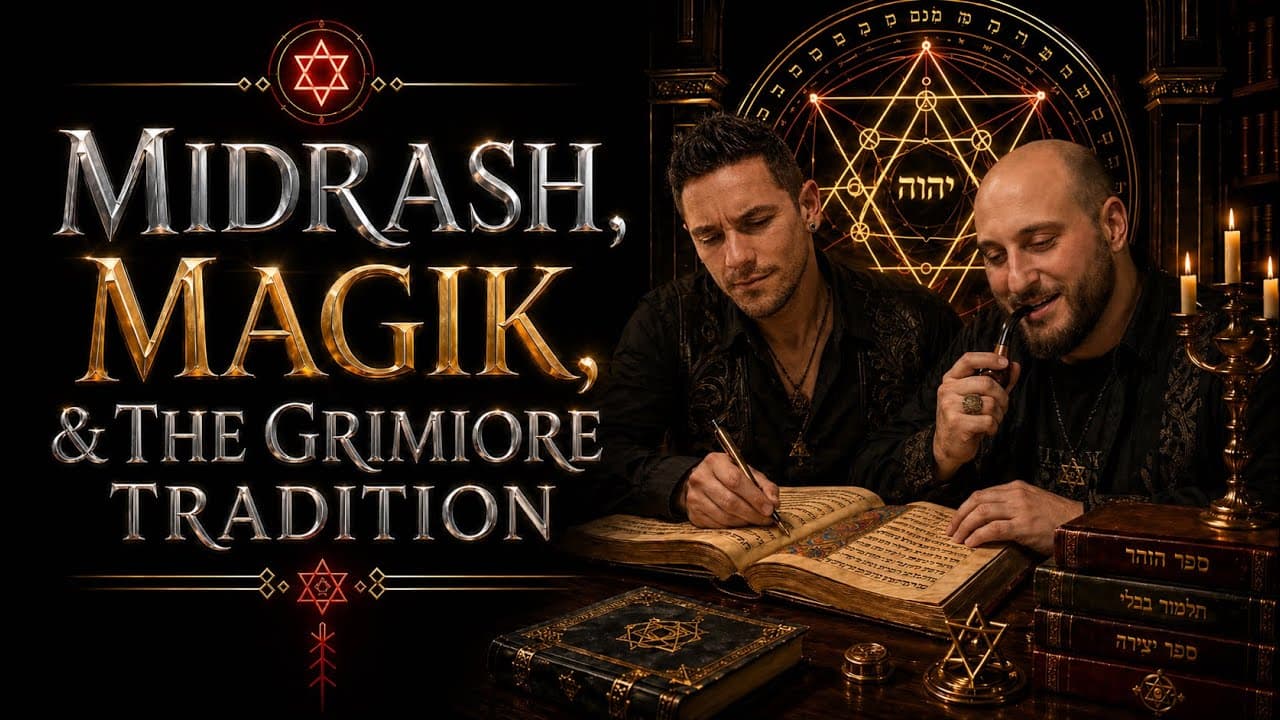
Ike lays out the difference between the Torah, the Tanakh, the Midrash, and the various layers of Jewish scriptural interpretation, showing how Kabbalah is not simply “Hebrew mysticism,” but a method of esoteric exegesis — a way of reading sacred text according to hidden, symbolic, numerical, and metaphysical dimensions.
The episode explores the Sefer Yetzirah, the Hebrew letters as creative potencies, the relationship between speech, number, writing, vibration, and creation, and the powerful Pythagorean and Hellenistic resonances that shaped later esoteric thought. The conversation then moves into the Zohar, Moses de León, Lurianic Kabbalah, tsimtsum, the breaking of the vessels, divine sparks, the qliphoth, and the cosmic work of tikkun.
From there, the discussion turns toward the magical stream: the Testament of Solomon, the Greater Key, the Lesser Key, the Heptameron, the Sword of Moses, the Ars Notoria, the Almadel, and the Arbatel. These texts are examined as part of a living grimoire tradition rooted in angelic hierarchy, Solomonic authority, demonology, planetary magic, talismanic work, and the larger Judeo-Christian magical imagination.
At the heart of this episode is a powerful idea: Western esotericism did not emerge from one isolated tradition. It was born from transmission, translation, commentary, ritual, conquest, exile, synthesis, and reinterpretation. Greek, Egyptian, Hebrew, Christian, Islamic, Hermetic, and Kabbalistic currents flowed into one another, forming the vast symbolic architecture that later became magic, mysticism, occult philosophy, and initiatic practice.
This episode is for anyone interested in the hidden roots of the Western magical tradition — where scripture becomes symbol, symbol becomes ritual, ritual becomes ascent, and language itself becomes a ladder between worlds.