Stage III: Advanced
The Path of the Theurgist
To understand theurgy as divine work done through the embodied soul, and why its tradition insists that purification and virtue come before any rite.
“It is not thought that unites theurgists to the gods … but the accomplishment of ineffable acts, performed as befits the gods and beyond all understanding, and the power of unutterable symbols understood by the gods alone.”
- Stations
- 6
- 5 marked chapters · 1 book
- Episodes
- 5
- Each opened at its chapter
- Of marked passages
- 14 min
- Where each station opens; listen on as long as you like
The route
6 stations, walked in order
Theurgy as Iamblichus defended it: the use of matter, rite and symbol to return the soul to the gods. The route moves from the philosophical aim, through purification and the sacred tokens, to the line that divides theurgy from goetia and the Golden Dawn's circuit of ascent and return, and closes with Iamblichus's own defence.
Keep each station as you finish it
Your place is kept in this browser alone.
Station IWatch· Kept
Locate the aim of theurgy
 Episode 22Neoplatonism, Theurgy, Christian Mysticism & the Philosopher-MagicianLands on Iamblichus, Matter & Theurgy Watch from 21:041 min chapter
Plotinus sought union through theoria, divine contemplation. Iamblichus answered that matter must be used: the divine is present in matter even though matter can express it only dimly, and the soul must climb back by means of it. That is what theurgy means here, and the Kabbalistic image of shattered vessels and trapped sparks is set beside it at once.
Sit with this
Plotinus would climb by contemplation, Iamblichus by matter. Which have you trusted more in your own practice, and why?
Station IIListen· Kept
Purify before the work
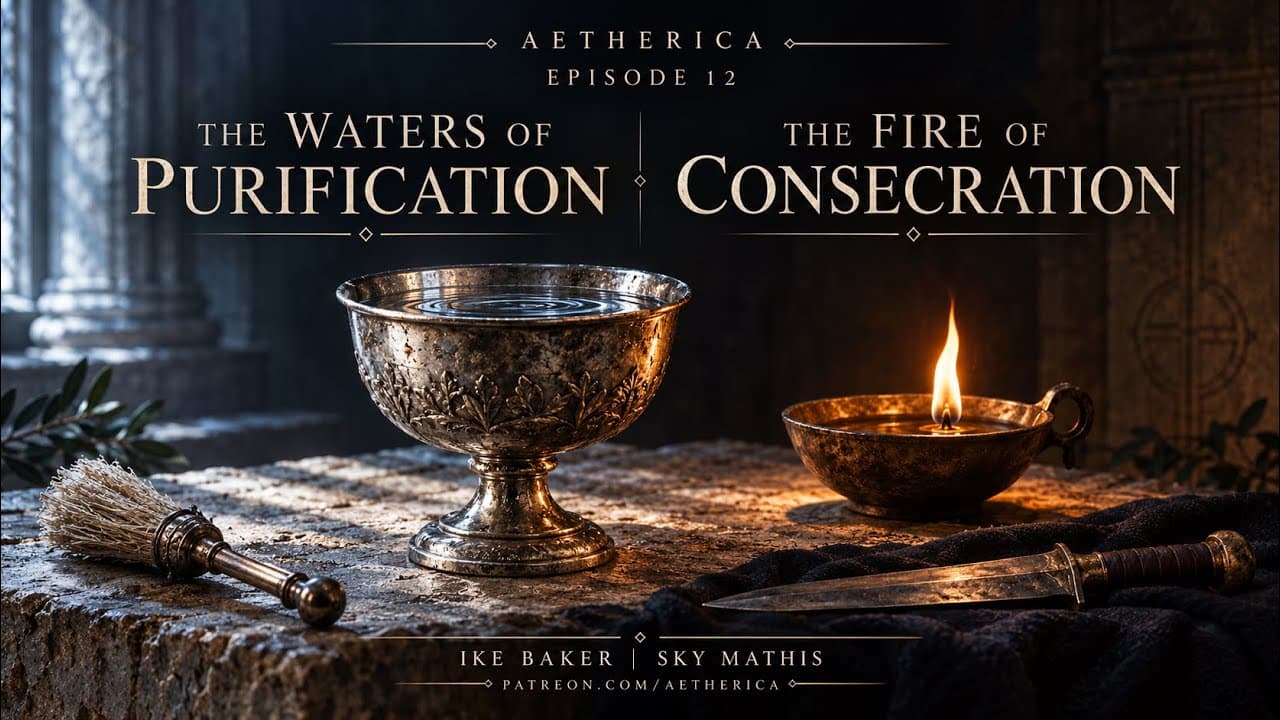 Episode 12The Waters of Purification, the Fire of ConsecrationLands on Chaldean Oracles and ritual purification Listen from 13:162 min chapter
Two Chaldean Oracles frame purification: the priest who governs the works of fire sprinkles with the lustral water of the loud-resounding sea, and when all phantoms are banished the holy and formless fire is seen. Purification comes first and is threefold each time a temple space is opened: psychological, etheric and astral, which are not the same thing.
Sit with this
What would a threefold purification look like before your next hour of study, and not only before a rite?
Station IIIWatch· Kept
Carry the tokens
 Episode 34Theurgy Podcast AethericaLands on Synthema, symbols, and hidden signatures Watch from 29:546 min chapter
In this long conversation between Sky Mathis and Ike Baker on theurgic practice, the discussion passes from magical words, divine names and the barbarous names of evocation to the synthemata: symbols and hidden signatures. Telestic art and the ensouling of statues, icons and ritual objects come next.
Sit with this
If the tokens act by a power that is not ours, what is left for the theurgist to do?
Station IVWatch· Kept
Tell theurgy from goetia
 Episode 24The Midrash& Magik, Creative Potencies, and The Grimiore TraditionLands on Goetia vs Theurgy Watch from 45:313 min chapter
Goetia and theurgy may use the same technique; what divides them is intention. Goetia is the summoning, conjuration or evocation of spirits of any rank toward personal gain, an object, a goal or knowledge. Theurgy turns the same means to a spiritual end, as a way of ascent toward henosis, union with God. Jake Stratton-Kent's argument in Geosophia that the two are effectively one is rejected, and the daimon of Iamblichus is described as an intermediary that may carry the soul to a further sphere.
Sit with this
If the technique is the same and only the intention differs, how would you test your intention before a rite?
Station VWatch· Kept
Ascend and return
 Episode 17Circuit of Force, Magnetic Interchange , Polarity Magic, Astral Light, Etheric Charge/ Forces #19Lands on Theurgy, Ascent, and the Circuit of Force Watch from 3:492 min chapter
The theurgic ritual of the Golden Dawn, grounded in Iamblichean theology, links the practitioner with the highest aspect of the self, rung by rung up the hierarchy of spiritual beings. The ascent is no escape from matter: one goes up in order to come down, returning with that fire to spiritualise matter and saying to the higher genius, work through me.
Sit with this
Would you rather remain above or below? What does the theurgic return ask of that preference?
Station VIRead· Kept
Read the reply to Porphyry
Read alongside
On the Mysteries (De Mysteriis)
Iamblichus
Iamblichus's defence of theurgy, written in the voice of the Egyptian priest Abamon in answer to Porphyry's letter of doubts about ritual. The archive calls it dense and obscure in Thomas Taylor's 1821 translation, with more theory than technique, and recommends Gregory Shaw's Theurgy and the Soul as a companion. A modern translation, such as that of Emma C. Clarke, John M. Dillon and Jackson P. Hershbell (2003), spares the reader Taylor's archaic English.
Sit with this
Read the passage at II.11 slowly, more than once. What is it that thought alone cannot do?
End of the route · its last question goes with you