Episode 16Length 39 min

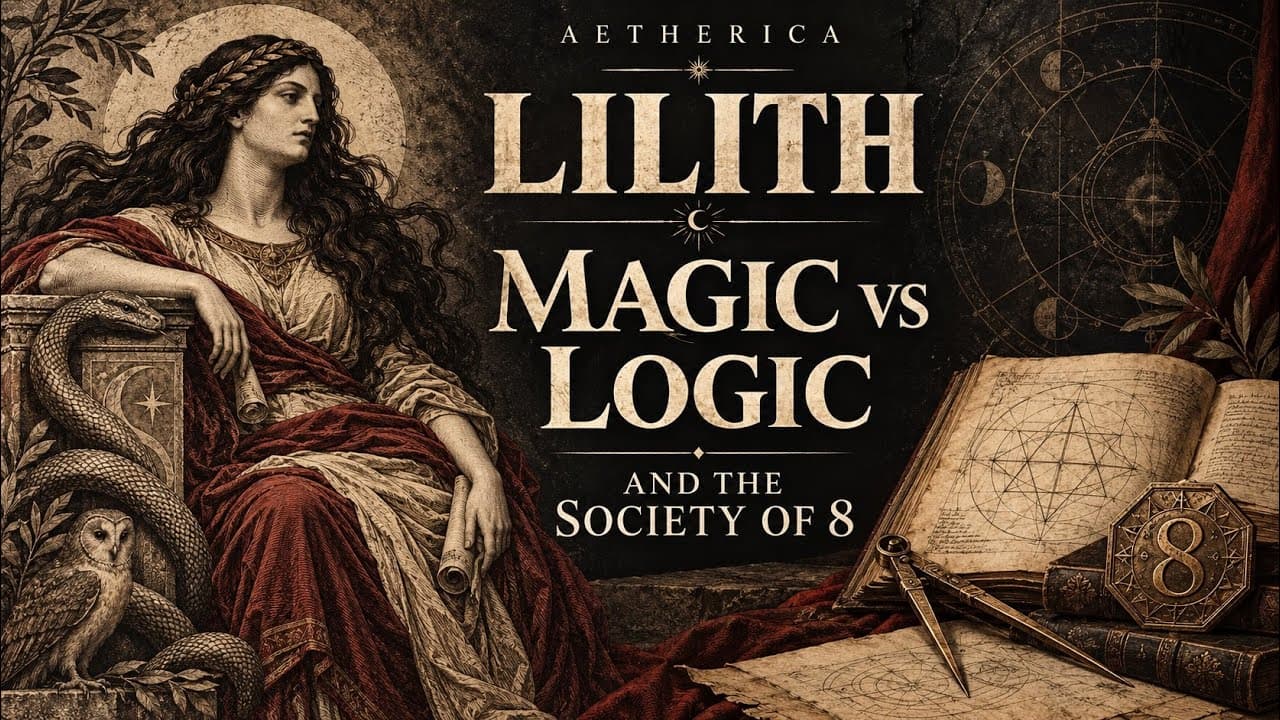
Lilith, Magic vs Logic, and the Society of 8

Hosted by Sky Mathis and Ike Baker

39 chaptersFull transcriptAudio and video

Show notes

The conversation

In this episode of Aetherica, we explore some of the most fascinating and controversial territory in esoteric thought: Lilith, the limits of logic, the nature of magic, and the hidden formation of the Hermetic Order of the Golden Dawn. The conversation begins with the figure of Lilith — her supposed relationship to Adam, her place in biblical and extra-biblical tradition, and the difference between later legend and actual source material.

From there, we move into Gnostic themes, including Norea, Eve, Sethian myth, and the role of spirit in esoteric cosmology. We then shift into a deep discussion on magic vs. logic: what logic actually is, where it breaks down, and why magical experience often appears non-logical rather than irrational. This leads into reflections on causality, truth, occultism, experience, and the limits of modern material assumptions.

Read the full notes

In the second half, we explore the historical roots of the Hermetic Order of the Golden Dawn, including the Society of Eight, Rosicrucianism, Masonry, the cipher manuscripts, Wescott, Mathers, esoteric Christianity, and the deeper theurgic current running beneath the Western tradition. This is a rich conversation on myth, initiation, source texts, hidden history, and the difference between safe reasoning and transformative understanding. Topics include: Lilith

  • Adam and Eve
  • Gnostic texts
  • Norea
  • Sethian mythology
  • Magic and causality
  • Logic and truth
  • Occult philosophy
  • Golden Dawn history
  • Society of Eight
  • Rosicrucianism
  • Freemasonry
  • Esoteric Christianity
  • Theurgy

From the show notes published with the podcast feed.

Chapters and transcript

The movements of the conversation

39 chapters across 39 min, with the full transcript beneath them. Choose a time to play from there. Open a chapter to read what is said in it.

  1. Play from 0:00Intro & audio quality discussion
    Read

    0:00So, it might not be the most amazing audio quality. Um, and we may end up releasing this as an audio only version, which is really weird because it's the first time we're in Burson together. — I know. — And um, but the thing is I think it's a great episode so far. — Me, too. — I wanted to ask you cuz I was what you were talking you brought up like Eve, Adam and Eve, and all that. And I was listening to some stuff recently about some different ideas related to

  2. Play from 0:55Lilith, Adam & Eve, and alternative traditions
    Read

    0:55uh accounts that involve Lilith in in the mix of things. And I don't think they're biblical, but gnostic perhaps or maybe there are some Gnostic texts that — I don't see I don't I don't really understand Lilith in a Gnostic context. I mean, if anything, there's Noria. Noria is [ __ ] cool. Um but uh Lilit is so there's a little it goes back and forth. People are claiming you know obviously it's it's like the same there's so much overlap between the

  3. Play from 1:29Two creation stories in Genesis explained
    Read

    1:29camps of like pagan witches and like this whole like weird um intersectional divine feminine kind of I don't know. I want to call it [ __ ] but that that might make people like unsubscribe. But but the thing it's like she doesn't appear in the Bible. Um the uh it's there is there's two creation stories. Um there there are two creation stories in in Genesis and people don't really understand that. Um both involve Adam. Um but in one of them he has uh a different he has a first wife. But the

  4. Play from 2:14Lilith in Isaiah and Hebrew interpretation issues
    Read

    2:14thing is it's not Lilith. It's not Lilith is only explicitly referenced in the book of Isaiah, the prophet Isaiah in the Hebrew Old Testament. And the thing is it's not it's it's assuming that that word mean is a proper name because the thing is, you know, there are many ways to interpret specifically Hebrew words because they're all consonants. There no vowels. There's no spaces. In original Hebrew, there was no dog to to like sort of, you know, uh, inform the pronunciation. It was just

    2:52assumed that you, whoever was reading this was going to be able to know what it meant. And obviously, you know, that's where this whole like cabalistic uh, exeetical tradition comes with Gamatria and they'll be able to read sentences like three or four different ways. you know, the Shem Kameffish coming from like three stacked lines of Hebrew text, you know, like they did they did all this word play with it because it was essentially like this grid matrix of words with no spaces, no vowels, just like just letters like

  5. Play from 3:25Development of Lilith in medieval folklore
    Read

    3:25almost like it would look like if you had wallpaper. That's what the the the the Hebrew Bible looked like originally, you know. Um, so we would have to assume that the the Lilit referred to in Isaiah is a proper name and is the first wife of Adam that we're talking about, which is a stretch, but needless to say, as many things happen during the Middle Ages, Lilith kind of um morphs into uh a a folktale type of retelling of this thing really she is she I'm pretty sure the root of her name means like demon

  6. Play from 4:06Lilith as demon figure and modern reinterpretations
    Read

    4:06but she's known as uh like the first demon and you know the female demon and the thing is or mother of demons really too um and the thing is this gets this turn this gets turned into like this kind of like you know anti-atriarchal um sort of retelling of of uh of Lilith how she she denied Adam sex and so she was cast out and and called, you know, she had the appellation or whatever. She was labeled a demon and it's and you know, and so it's like you you're kind of like it's this it's this it's this fantasy

    4:46play that you're feeding to to to people like about I was like, you know, that reminds me of the time that I was a [ __ ] idiot and people made me feel bad and and I I was the I was the outcast. But in reality, none of that is in the [ __ ] Bible. Zero, — right? Are there is there anything in like say like the Nagamadi or like just Gnostic text in regard to Lilith that involved Adam? Like the thing that I heard — Yeah. that they were confidently talking about was this story and it was basically like

  7. Play from 5:22Lack of Lilith in primary source texts
    Read

    5:22Lilith riding Adam on top upset Adam like sexually and he was like complaining to God about how he was disappointed because he didn't feel like he was like dominating the situation like something like hilarious along those lines but that this was I I I don't know anything in the Gnostic text that talks about Lilith to be honest with you. — Um that could be — that could so that could be my own ignorance because the Gnostic texts to read the Gnostic text is like reading maybe like two two more Bibles,

  8. Play from 6:01Gnostic texts and uncertainty around Lilith
    Read

    6:01— you know? So, it's like it's it's not been exhaustive. But my understanding, and I would love if somebody were to to inform my understanding or prove me wrong, and go and do this research since I'm doing all this other [ __ ] research and giving away for free, — go find where it says that Lilith did these things. Not where they have been rewritten, but go to the source material. I So don't come to me with with [ __ ] "Oh, look right here. This dates from the 9th century." That's not

    6:30source text. That's a legend. That's a myth. We see Lilith kind of developed in Gnostic myths. We see Lilith developed in Hebrew myths. We see medieval myths. We see Lilith in the in the the the sort of like their brother brother sister Semitic relationship of the Arab sort of um the Palestinian variety. We don't see Lilith, as far as I am aware, as she is being portrayed, specifically as she is being described in any source document. I could be wrong with the Gnostic stuff. I'm just saying that full

  9. Play from 7:05Norea, Eve, and Gnostic creation narratives
    Read

    7:05disclosure, but people like to talk talk about the second creation story. People like to get super specific about biblical stuff. And if we're talking about the canonical Bible, it's not [ __ ] there. Mhm. Yeah. Clearly. — Clearly. And the thing is, — my question wasn't about the canonical Bible. — Yeah. So, Gnostic stuff I'm not I'm not aware of, but everything that I have read, you know, things like the secret book of John, the Apocrypha or the uh the um the

    7:36— uh what do you call it? The the hypotheses of the archons. There are other there's lots of sex, rape really um with sort of fallen angelic entities, but it's primarily with Eve. and it's attempted with Noria. — Okay. — Um and Noria uh kind of just laughs at them. That doesn't really work with with her. And and even there are some things in Eve where she goes out of body uh you know and and and all that stuff and is able to escape the um that's how Seth is

  10. Play from 8:08Birth of Seth and spiritual vs material lineage
    Read

    8:08born — really. The the the the the Sethian savior is that when she's being raped the first time, she's suffering all this. She well she she's suffering all this material stuff being raped by by by the fallen angels that covet her and so she goes out of body. So the children that she has don't have spirit because her spirit wasn't in the body. They are children of only flesh and blood. They're not children of any spirit. And that's why Cain kills Abel and they become like a disappointment because

    8:38they're born of this evil lustful spirit. Whereas Adam, you know, and and Eve now copulate and in the spirit of love and she her spirit remains in the body. And since she she has she has this experience of love with her spirit, they give birth to a child of flesh, blood, and spirit. And that is Seth. And Seth creates, you know, according to the traditions, Seth creates the line, the the un the the unbreakable race of Seth who that are like what they consider themselves the true gnostics. We will

All 39 chapters
  1. Play from 9:13What is magic vs what is logic
    Read

    9:13keep reincarnating. We will keep coming back. So that's that's as far as as my own personal understanding of that. — Yeah. Other thing I want to ask you is when we're talking about magic and I was asking about your experience or how you would relate or describe magic and you said something along the lines of it not being logical. This might be annoying but like just for the sake of me contemplating and if I want to ask another question like what what is logic? So that depends on like what century

    9:56we're talking about and and who we're talk and who we're asking. Let's rather than kind of go off into all these like discursive pathways and like okay who was the father of logic? Was it Thales? Was it Aristotle? Um, logic is a series of causality which has known and assumed sort of parameters. So something that is illogical will not follow the known and assumed parameters. It will not be obvious to its own sort of rationale. — Okay. — So in other words like the logic behind

  2. Play from 10:51Logic as causality and observable sequences
    Read

    10:51something is kind of like the the causal series is that an empirical repeatable sort of empir um causal series. So I take my phone that's in my hand now and I walk it to the end of the hallway. I place it on the floor. — You know if that's what that's what we're talking about. Okay. So then so that is that is a that is causality. I went and did that. Something that is illogical has no apparent causality um in in terms of you know and there's different kinds of logic that we're

    11:25talking about. — Okay. I can see that — I'm kind of talking about the overarching — the that part I could get. But like then when you're talking about known and assumed parameters, would you say that say like within a traditional system like the hermetic order of the golden dawn, there are known and assumed parameters? — There are what I'm talking about here is is logic has its own known and assumed parameters. Like logic will force you to make an a priority judgment. That's the

  3. Play from 11:57Limits and assumptions of logical thinking
    Read

    11:57whole thing. Like the whole idea behind logic is that people are able to say ghosts don't exist because they can't regardless of any experiences that they've had with so so that that's kind of it seems a causal. It seems like there's no causality specifically with logic uh with something that's illogical. So people like to say that okay logic is safe. Really what it is is it's safe. People like to say logic is the way that we investigate nature because nature has causal chains.

  4. Play from 12:32Logic vs truth and experiential reality
    Read

    12:32Nature, as we see from science, as we see from our material observations, there are causal chains. Nothing can just happen out of thin air. So that is what our logic is based on. Really, logic is safe because things happen out of thin air all the [ __ ] time. But the thing is we we stick with logic. So that's like basically out of all the broadband spectrum of let's compare experience only to color, right? We we know that color exists beyond our visible spectrum, but all we can experience is the visible spectrum.

    13:06So it's logic said will will take a look at a very very small band of that spectrum and say okay these are the assumed rules. This is how pink works. I'm using this as an analogy. — This is how pink works. We know pink. So anything that happens outside of pink can't happen because because these are the laws of pink. So it's basically shortening everything. But we view it as this very sophisticated way because we've been able we've been able to accomplish a lot by logical thinking.

  5. Play from 13:38Spectrum analogy for understanding truth
    Read

    13:38— So logic is not representative. It can help to lend understanding about truth but logic is not synonymous with truth. Logic can only logic can only lead us to a certain kind of understanding of a very small spectrum of of of the the the the spectrum of capital T truth. It's like a a an a proximal system of arriving at truth, but it's not a — Well, the thing is it's like there's logic that's mathematical and there's logic that's philosophical and then there's logic that's just taken for

  6. Play from 14:17Different types of logic (philosophical, mathematical, common)
    Read

    14:17granted the way I would commonly say logic. — Yeah. — Right. So, so the thing is like really when we talk about logic, we're talking about methodology in a lot of ways, but the main thing is causality like a causal sequence. Something that's like, oh, I see why this happened. It happened because of what happened before it. But then there are probably obviously assumptions made about logic. Like somebody, one person could say it's logical. this is a logical causal chain and

    14:51somebody else and maybe yeah I guess you could say yeah it could be a logical causal chain but that's not the reality — right — of it it's just a logical — right and you got to understand that I didn't say illogical what I said earlier I said I said non-logical — because I don't mean to imply that it doesn't make sense it does make sense it just doesn't follow the small group of the small like list of imposed thing requirements for I guess what I would

  7. Play from 15:22Non-logical vs illogical in magic
    Read

    15:22say what I would call common logic — common logic yeah I guess like when I more I think about everything it's like everything is relative — everything yeah — and everything is — but there is objective truth it's just not here — yeah and that truth that objective truth can be arrived at through means that are not logical — it they have to transcend logic — and that's more along the lines of what things that are associated ated with magical understandings

    15:49— from the point of of the more especially because don't forget magic doesn't have to be spiritual like the the occult doesn't mean spiritual — it doesn't mean satanic either — but it doesn't mean spiritual like occult means hidden — and that's what we're talking about when we talk about things that are non-logical there's a sequence we just can't see it it's not apparent to my sense perceptions it's the five senses that we're constantly relying on. There

  8. Play from 16:18Occult meaning “hidden” and unseen causality
    Read

    16:18are other senses that we have neglected and they have atrophied because of our heavy reliance on, you know, the five senses that reside in our [ __ ] head, you know. So, so that that's the whole thing. It's safe to just say that, oh, logic is the only set of rules, but in reality, logic is a one set of rules for a very small portion of reality. Yeah. And capital D truth has nothing to do with discursive methods. Capital T truth has to do with experience. Capital T truth is noises and it's true for

  9. Play from 16:49Non-theurgic magic and practical examples
    Read

    16:49everybody or it's true for nobody. So in like in terms of experiencing magic and describing to the best of your ability using the framework of it being non-logical if it's not in a theorical context. What are some examples of magic that could occur non theo non- theurgogical? Well, like just money magic, anything really. Like it's like, okay, here's the thing, you know, we we can talk about things have to be happening in your life in order for you to that's what I would say. There's something that that's

  10. Play from 17:33Sphere of availability explained
    Read

    17:33called I I don't know who coined this term, but I heard it from Augustino Tammaturo um you know, or Father Jason Spataphor. — Okay. He writes in his Augustino Tamura, he calls it the sphere of availability. So if you do magic for money and then you don't [ __ ] do anything, you have a very small sphere of availability, which means that there is a high probability that nothing will happen or something very, very minute will happen. Now, there are some people that will deny that like, no, no, no. I'm

    18:10surrounded by spirits. It's like I will send them and they will get this thing for me and it will arrive and everybody will be safe and it all be good. Um I kind of don't take their word for that. Um now so the thing is like okay like for me right I did some I did you have to do planetary magic obviously in the golden dawn. I still do it but when I was first starting I was practicing I was not in ritual regalia. I did not open up the way I I I was supposed because I was just practicing the hexogs

  11. Play from 18:41Jupiter ritual and unexpected raise example
    Read

    18:41and for that day Friday I was or Thursday I was doing Jupiter because that's the day of Jupiter. I did it a day and hour of Jupiter right then I go to work and my boss says you got a raise and I wasn't even trying it was practicing. So but the thing is I went to work. — Yeah. I had a job. You know what I'm saying? And it it's completely non it's illogical. It seems like there is no cause or it seems that my my correlation of the two is completely arbitrary. Fast forward to the next day, Friday. I do uh

  12. Play from 19:20Venus ritual and unlikely social encounter
    Read

    19:20the I'm practicing again the uh the the hexog of Venus. I go to work. Now I'm on my lunch break and I decide I'm going to go to a cafe. Okay. It's the same cafe I've been going to since I was 14 [ __ ] years old. Now, as a young man, you you you know, I'll put it this way. Rarely would a young man, single young man, turn down the opportunity to speak with, you know, maybe a friendly new stranger of the opposite sex, okay? Or or of the same, depending on your your your disposition.

    19:56From the time I was 14 to the time I was about 30, nobody had ever ever approached me in this entire [ __ ] never ever ever ever. And I used to go there four or five times a week. And on the same day that I do the that I'm practicing the Venus invocation, pretty young lady comes and sits down and starts a conversation the first [ __ ] time in 16 years. — That's wild. So th this is these are the things I'm it's it's it's not it's non it's non-logical but it happened and there's a very

  13. Play from 20:31Magic as probability-defying correlation
    Read

    20:31specific relationship between what I did and what happened — that actually defies probability. — That's a good way to put it. — And you have to in order for you to say no no no you know it doesn't defy probability then you that's really magical thinking. — Mhm. — That's really a stretch. Now you're Now you're really fooling your [ __ ] sucks. — Oh, that's Yeah, — you know, — I like that. All right. I want to ask

  14. Play from 20:57Golden Dawn origins and historical roots
    Read

    20:57you something that you mentioned earlier about um like things in regards to the formation of the system of hermetic of the old order Order of the Golden Dawn maybe like being built and constructed from guys like Wescott and Mathers and — Mhm. — whoever else. And but like talking about it in the sense that it was in the format that it was produced in the 1800s or was 1888. — Yeah. But you know they had been working on it for many many years. Wescott actually was a part of a a small like

    21:43clandestine group of Masons called the Society of Eight and they had been working on this stuff for a really long time. — Oh interesting. Yeah. — And then so would you not say or would you say that it has roots in old world understandings or older times in terms of things that were like recognized about processes and practices — 110%. And not only that, the more work and research that I do, the more I stumble upon, right? because I have a very very strong familiarity with the

  15. Play from 22:21Pagan theurgy and Neoplatonism influences
    Read

    22:21Golden Dawn. — Mhm. — So I go out and I work and I research and I do you know minor personal translations and I'm putting corroborating also putting test uh putting classes in curriculum and talks together and the more I do that the more I realize that they were drawing from Agria they were drawing from fino they were drawing from they were drawing from Platinus they were calling directly from it. So those sources uh before ficino were pagan. Embleian theorgy is pagan. Proclus

  16. Play from 23:01Christianity as culmination of theurgic model
    Read

    23:01platinus plato himself pagan — but they're talking about theergic processes of philosophy. Theoria theoria divine ascent. If if there is any pagan religious stuff it's that. Yeah, — that's what it is. But really, the trajectory is modeled is archetypally subsumed in its most perfect iteration by the story of Christ. Get all the church rules out of your [ __ ] head. Forget them, but don't throw the baby out with the bathwater. Christ is valuable. Christ, the idea of the

  17. Play from 23:42Esoteric vs institutional Christianity
    Read

    23:42cristic force of Christ itself is paramount. It's the most important part of our spiritual tradition. Churchianity is not I don't give a [ __ ] what what days you want me to eat, what days you want me to not eat, what days I can [ __ ] my wife, what days I, you know, I have to go and and pray all day. It's not that's not for you to decide. — But Christ is is important because Christ is the theoric model. Christ is what happens when you accomplish the perfectly. That's why Christianity came out of

    24:15Hellenism. It did not come out of Hebrew. It did not come out of Judaism. It came out of Henanism. It came out and if it and it was related to he uh Judaism obviously, but it was helenized Judaism. It was the Jews in Alexandria and you know and surrounding parts of the the Mediterranean that that had been influenced by henistic philosophy and religion. So if there's any paganism, it's there. It's it's in the theurgic stuff that leads us to Christianity proper. — And we're were these Christian

  18. Play from 24:53Society of Eight and early development work
    Read

    24:53conceptions involving Christ in these ways held within that original eight members of this group that you're talking about, — the Society of Eight. — Yeah. But the society of it was more like they're developing ideas. They're developing tarot card correspondences. They're developing cabalistic stuff. Wasn't necessarily the hermetic order of the Golden Dawn proper yet. That was that was something that I think truly was um that was in Wescott. — There's a lot of mystery surrounding it

    25:27that we'll pro will likely never know about what was going on. But my best guess after reading about 12 different [ __ ] books and you know reading all of his literature through it's been passed down to me through the order the flying roles his speeches his eulogizing Bllovatzky uh for the Theosophical Society because he was a member his participation in talking about the Rosie Crucians you all this stuff all of this stuff leads me to believe that Wescott was really the man behind all of the

    25:56Golden Dawn and Mathers was a brilliant magician. and ritualist. So he employed Mathers as to kind of help him with this workload and to to really flesh the rituals out. And of course Moina Mathers or Mina Bergson was her proper name. Meet Mina Mathers after they married. She was really the clairvoyant and psychic genius. She did a lot of the heavy lifting in terms of the vision work that went into the Golden Dawn curriculum at the higher levels and things like that. But um this conception of esoteric Christianity

  19. Play from 26:37Roles of Wescott, Mathers, and Moina Mathers
    Read

    26:37I can't say too much especially now that you're an initiate but I will tell you this because in that welcome letter that I gave you it says the same thing. I'm not tell I'm not saying anything now the chick hasn't written Christianity is is really you need to be able to work with all all symbol systems because we don't abandon the stuff that comes before Christianity but Christianity esoteric Christianity is is the heart of the golden dawn completely but you don't get it until you're you've

    27:09become an adept of the golden dawn — and was it always the case that the golden dawn was an outer order of the inner order in terms of like the rose of Christianism or did they emerge in tandem or was that an adaptation or an innovation? — It was it was um I'll put it this way. um the the inner order curriculum and the working out of certain the understanding of the ritual documents came later. So essentially what happens is this they inherit some a group of documents called the the cipher manuscripts.

  20. Play from 27:56Cipher manuscripts and building the system
    Read

    27:56Now people say they're forgeries. Here's the thing. Let Wescott's letters from Froline Sprangler what a SND this German adept for anybody who knows about the Golden Dawn. For anybody who doesn't, I'm going to do a massive history on the Golden Dawn this winter. So, you'll be well acquainted with all this stuff, but his letters may have been forged, but not the cipher manuscripts themselves. And so, the cipher manuscripts are ciphers, right? That's what a cipher is. It's code and it's an encoded document

    28:32that gives the curriculum and the rituals of the of the hermetic order of the golden dog in the outer. And so they, you know, it's just a bunch of stuff. It's a bunch of stage directions and very obscure dry stuff and these little weird, you know, filled this very strange marginalia. I think like the first thing like on one of the first pages is it just says in the margins avoid Roman Catholics but out of pity — you know like it's these very strange like notes and things like that and uh

  21. Play from 29:05Development of rituals and curriculum
    Read

    29:05what they have to do is they have to turn they have to flesh this out into rituals and and and and some kind of working curriculum which is which is what they do. And then once they have fleshed all that stuff out and designed it, then they begin to try to understand it and it just goes deeper and deeper. But from the beginning there was always the idea of an inner order and it was always rosy cushion. What you did in that inner order, what those rituals looked like, the things you practices and practiced and studied came later.

    29:38But there was always an inner order that was um explicitly Razi Krishna. Okay, — we're at the 30 minute mark. So, — you got any any last things or any closing remarks? — Any closing remarks? Um — or any any other question? Yeah, I do have another thing I think would be interesting to get into and that is that I find it interesting that you talk about this original these eight individuals that were Masonic. But isn't it the case that it's not um generally accepted for Golden Dawn

  22. Play from 30:31Golden Dawn relationship with Freemasonry
    Read

    30:31activities to take place within Masonic institutions? — Well, the thing is the society of a like I said earlier was not the golden dawn. — Mhm. They some of the curriculum some of the I I'll put it this way. The cababalistic correspondences in the tarot — came from the work of of the society of Wescott began so Wescott had this whole trajectory where he he he quit his job for two full years. He took a hiatus. He went on temporary leave for two years to lock himself in his London town home

  23. Play from 31:06Kenneth MacKenzie and possible manuscript origins
    Read

    31:06with his family. several children as a young man and he studied the cabala for two years. — Okay. So then he comes out and he joins this society of eight and I believe Kenneth McKenzie was you know very very influential Mason during that time um uh very esoteric Kenneth McKenzie had actually spent time with Elephice Levy he was like the bridging gap between that those generations um and uh it's believed that actually one of the theories of where they got the cipher manuscripts was after Kenneth McKenzie's

    31:40death. They they inherited them. So they either found them or were given to him. There are all sorts of stories, but but that's a theory that Kenneth McKenzie was working on these things. Okay. Well, even regardless of that Rosacrianism Mhm. I guess I'm not as confident in understanding the origins, but there are masonic or Christian bodies. — Yeah, absolutely. And if there are there's an outer order. — Well, the the Golden Dawn was completely indep. — They did not operate with any Masonic

  24. Play from 32:19Independent Rosicrucian identity of the order
    Read

    32:19charter, — but they did have a charter from a lodge of the gold of this this uh I forget what it was called, the um Morgan Lot or something like that. Um but uh they um they found an order apparently they had contacted an order of continental masonry in Germany or Austria those areas and that's where they claimed to get their charter but it wasn't it wasn't regular English masonry. Um and so the thing is they met clandestinely this group of they didn't they didn't report their

    32:58findings. We know they they weren't like meeting and recording like official Masonic minutes. They were a group of esoteric masons that got together to do some of this work. And we know about it because we have their journals. We have Wescott's journal. That's how we know it even existed. So the Golden Dawn then gets started later with a lot of those cabalistic and tarot correspondences. they were working through the stuff that like you know Corteblin and and and Aelier were were kind of um fleshing out

  25. Play from 33:30Masonic vs non-Masonic Rosicrucian bodies
    Read

    33:30in in French masonry and and and and then the tarot in in France you know a little bit earlier and around that time. So then they really what happens is it's after they find the cipher manuscripts William Robert Woodman uh William Wyn Wescott and Samuel Little Mathers they start the Golden Dawn and but the thing is it's yes they are high-grade Rossy Christian Masons but they didn't they the Golden Dawn had a separate claim to Rosie Christianism they undoubtedly would have viewed it as the same

    34:06— they would have viewed it as an expans expansion they would have said this is true masonry but a lot of people were doing that for a long time especially in France you know you got Kagliostro and his right of the Memphis mis rhyme saying okay this is the true face of masonry and and it was is all that kind of experimentation but the thing is they weren't really like people would it wouldn't even been like masons were like the golden dawn can't meet here it would have been like what the [ __ ] are you

  26. Play from 34:34Evaluating orders by spirit and intent
    Read

    34:34doing why are you dressed as Egyptians why are there women here it would have been like we don't know what you're doing, — you know, like what someone please explain, you know, so they didn't meet in Masonic holes. — And there are differences between Masonic Racristian bodies and non-Masonic Rosian bodies or is there some — there for everything that exists Masonically, somebody somewhere got an initiation, either drew up a charter or found somebody who would draw one up for

    35:01them, and they make [ __ ] outside orders outside of masonry. That's not a judgment. That's just the facts. And some may be better and some may be worse. — Um, yeah. I tend to characterize it by how what's the overall intentionality and the the the agregor of the group. Are these people My thing is I'm big on spirit. — Do you are you animated by the spirit with which you claim to be allied? — If if you don't embody that, then I don't care if you're Masonic or

  27. Play from 35:27Rosicrucian secrecy and the invisible college
    Read

    35:27non-masonic. — But another thing is like most of those people won't like come out in the open waving their charter saying over here, over here, Templar's over here. you know, uh, Rosa Christians over here. It's it's it's mostly they're doing quiet, private [ __ ] work. And when I do see people who jump out and start kind of like again that, hi, my name is Christian Rosenro, you know, then I'm like, okay, I'm worried, right? Because what's this? What's the first thing about a Rosie

    35:54Christian historically? — Blend in with your country or something. — Very good. Very good. Right. that you're they're admonished to wear the clothes of the country in which they live and what and in all their writings say you won't find us we'll find you because a Rosie Christian was like Rosie Christian was invisible nobody's supposed to know who is a Rosie Christian they were called the invisible college no one was ever supposed to be a known Rosie Christian so when people step up and say

  28. Play from 36:26Finding true orders and authentic practitioners
    Read

    36:26I'm Rosie Christian I get it times have changed we're working in this very complex and nuanced system of esoteric orders now trying to figure out the internet, you know, but it's just not that's not one of those things where you you want to see like the head guy shouldn't come out and start talking about how he's a [ __ ] Rosie Christian. You know what I'm saying? It's just like be be quiet, do your work because um there is a community of people out there that are very serious

    36:54and very dedicated and if what you're doing really has the spirit, they will come to you. You know what I'm saying? It's it's one of those things where it's like you'll find each other. You know, when it's an extension of the hermetic axiom, when the student is ready, the master appears. You know, it's the same thing for these orders. They will, if it's true, you your order will populate itself with good people. — I think that's a good place to leave it

  29. Play from 37:25Closing thoughts and future collaborations
    Read

    37:25on. — Awesome. — Oh. Uh this has been another episode of the podcast live in person. Unfortunately, this segment is not going to have any visual even though we are in person. — We're still here. — We're still in the library. — Yeah. Thanks for listening. Do you have any closing thoughts? — Thanks for coming all the way out here, man. — Yeah. Thanks for having me. — Yeah, — it's been blast. — It's been fun. I'm sure it'll be more

    37:56times to come. — And be on the lookout because we are both flying back to well Skye's flying back. I'm flying to Phoenix tomorrow, Arizona where we will be meeting Tuesday with our good friends Jamie Paul Lamb, Jake Treyer, and maybe Pat Shanahan. I'm not really 100% sure if he's actually going to be there, but we're going to do a tripod. Yeah. So, I know that this isn't coming out live, but that if if you weren't aware of the tree arcana minds, that is Tria Prima

    38:31Arcanum Philosophical Minds, basically, you know, Ether and those dudes. Then, uh, go find that. Go check that out. It's got to be on one of our channels. Boom. There it is. All right. Farewell. Good night.

Listening paths

Walk this episode in a listening path

One guided path stops here on the way through.

  • Advanced path

    Station 3 of 6

    Martinism and Reintegration

    See Christ as the theurgic model

    Researching the Golden Dawn's sources, the speaker finds it drawing directly on Agrippa, Ficino and Plotinus, and behind them on a pagan line, Iamblichean theurgy, Proclus, Plotinus and Plato, all describing a theurgic process of divine ascent. That trajectory, he argues, finds its most perfect form in the story of Christ. Christ is the theurgic model, what happens when the work is accomplished perfectly, and the Christic force is set firmly apart from the rules of institutional religion.