Episode 2Length 41 min

Power, Heresy, and the Evolution of the Church (Ike Baker · Sky Mathis)

Hosted by Sky Mathis and Ike Baker

22 chaptersFull transcriptAudio and video

Show notes

The conversation

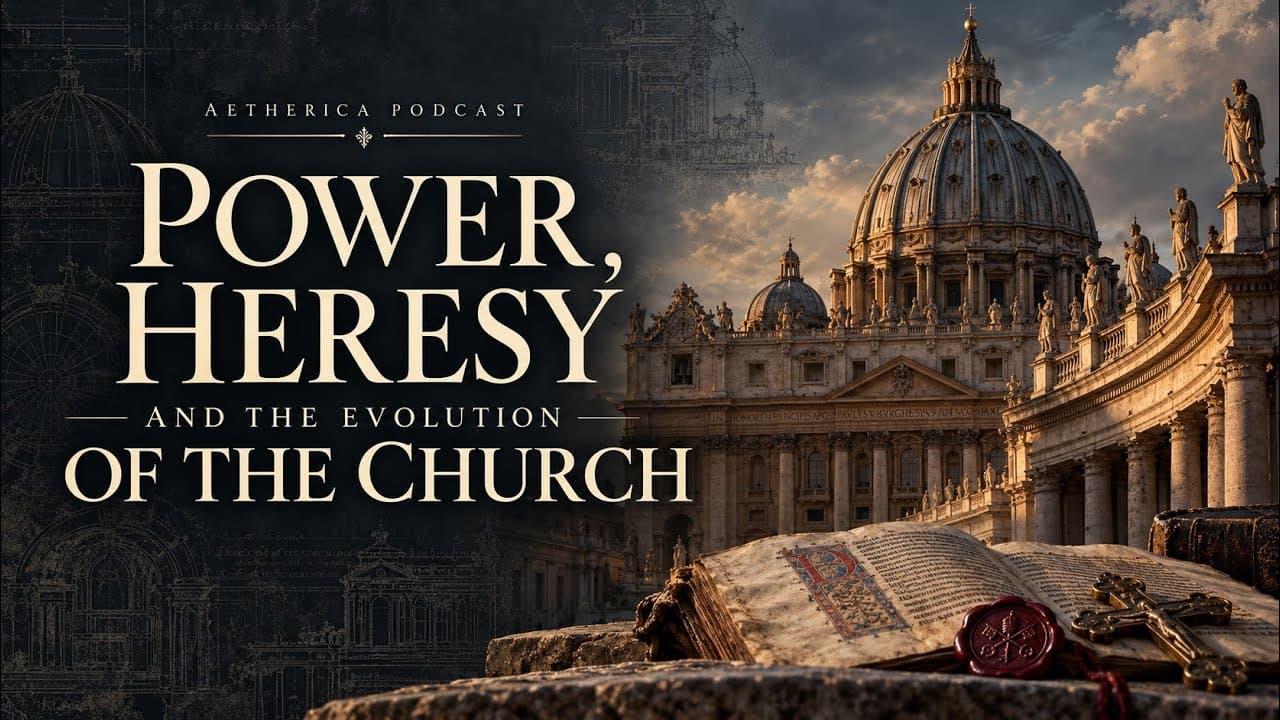
In this compelling second episode of Aetherica, Sky Mathis and Ike Baker trace the long arc of power, orthodoxy, and dissent in Christian history. The conversation opens with reflections on the Reformation and the question of whether institutional reform truly transformed the Church's deeper struggle with authority. From there, the hosts examine the shifting nature of persecution and inversion — how in earlier centuries the Church pursued heretics, yet in modern times many sincere believers feel marginalized by secular culture.

This inversion becomes the framework for a larger meditation on the cyclical tension between spirit and power, faith and control. A key portion of the dialogue explores the Greek origin of the word "heresy." As Ike explains, hairesis (αἵρεσις) simply meant "school of thought," not rebellion.

Read the full notes

It was the early heresiologists such as Irenaeus and Hippolytus who redefined the term, transforming a neutral label for philosophical diversity into a moral category of error. The hosts note how this linguistic evolution mirrors a spiritual one — from open inquiry to doctrinal enforcement — and how that shift continues to echo within modern consciousness. The tone remains reflective and historical, blending scholarly insight with contemplative questioning.

Rather than condemning or defending orthodoxy, Aetherica frames the story of heresy as an allegory for the human condition: the eternal struggle between the pursuit of truth and the consolidation of power.

From the show notes published with the podcast feed.

Chapters and transcript

The movements of the conversation

22 chapters across 41 min, with the full transcript beneath them. Choose a time to play from there. Open a chapter to read what is said in it.

  1. Play from 0:00Catholic reform, power, and persecution
    Read

    0:00[music] [music] Well, there was a reformation in the Catholic Church uh in particular, but it it didn't do much good. Um I don't think that I don't think that there's any active sort of push to get the the the regions of the world to um to begin killing heretics. I think if anything, Christians, even innocent Christians are under attack right now. It's kind of the inverse. — But [clears throat] you really see it, you really see it with with just power in general. You see it with power in

  2. Play from 0:43Heresiologists and early Christian doctrine
    Read

    0:43general. And it's been the story of the Catholic Church of the church in general after, you know, after Christ and the apostles, this power struggle has been an issue. I mean it's debatable right because in in early Christianities you even saw it in like the heresiologists like uh Irenaeus and Hippolitus and — what's a heresiologist? — Uh is that like a heresy heresy? — Yes. These were the men these were the men who railed against heresy. So heresy comes from the the Greek word hieris

    1:22which means school of thought. That's all it means. It's like like you know in the original Greek the context they were using it in was saying this school of thought is wrong you know and we derived like oh they're heretics because they're hyasis um but what they did was they basically attempted to systematize uh Christian teachings and Christian doctrine Christian dogma and uh they were we have their writings whereas we don't we didn't have a lot of the writings of the people that they kind of you know uh

    2:02had these pmics against. So we based a lot of our understanding of the early Christian schools of thought off of basically you know uh the propaganda of their opponents who just so happened to have their works preserved — um like Irenaeus Hippolitus Justin Martyr etc so on and so forth um Epipanius uh [clears throat] Clement of Alexandria was a little bit more um he was a little bit more amunable to you know particularly the Gnostic schools But there was that power struggle from the beginning pretty much

  3. Play from 2:36Vatican history, papacy, and Roman context
    Read

    2:36immediately after Christ, you know. Um, one of the interesting things that people don't really have a very firm understanding of the history of particularly when when you talk about things like the Vatican and you talk about things about the papacy, it's very confused, you know, because a lot of the information we're getting is from people who didn't bother to learn any of this [ __ ] you know? They're just like, "Oh, well, you know, I'll go as far back as the 1500s, but after that, [ __ ] it. I

    3:02found You know, it's like, you know, you got you got to go and that's the trouble with me. I've got to go as far back as I can to figure out what all what all this stuff means, you know? Um, that's just what it is because then you don't have context. You you might have like a gotcha moment on paper, but it's like that's not context. You know, you're going to run into somebody who knows more about this [ __ ] than you do and he's going to pull your pants down, you

    3:26know? So, it's you you've you've got, you know, you've got to go back. But really the thing is the the so the Vatican again is the seat of is is the the the physical headquarters for the Holy Sea which is the political or or the I mean let's face it he's political uh political and and religious power of the bishop of Rome that we call the pope but that is the western church That's not the Eastern Church. So, and [clears throat] that's not the Protestant church, right? Those the

    4:09Protestant church were are a group of, you know, clerics and and and things like that, kings and stuff. you the Anglican church they rebelled against the dictates for one reason or another and and they kind of reorganized Christianity their own uh dogma which is just you know it's only different from Catholicism because Catholicism changed their doctrines very slowly over time whereas like Protestants changed their doctrine immediately um and had like a a a very very um quick a very very rapid

    Close chapter 3
  4. Play from 4:45Constantine, Christianity, and the Roman Empire
    Read

    4:45break with with the main church. But it, you know, all of this stuff really starts not only with Christ, but with Rome, right? Because he was Christ was born during, you know, uh, the Roman Empire really. And so what I found really interesting, I used to read a lot of science fiction. I love Philip K. Dick and I loved his his vast trilogy. And one thing that that he really pointed I think you really hit on something in this even though it was kind of fiction. He says um in in one of the books of this trilogy that Rome was

    5:20the empire that never ended. M — and I was scratched my head for a little while thinking about that and then I really understood what he meant because you have essentially the Roman Empire under Constantine the great Constantine the first in three 313 CE he releases something called the edict of Milan basically saying look we're not going to just randomly arrest these people and kill them for fun at the coliseum we're not going to feed them to lions anymore more um just because they're Christians, men,

    5:55women, and children. Right? So that's I mean that's the persecution the early Christians had to had to deal with. You could be a woman at the market with your child and be pulled off the street because you're a Christian and then you could be fed the next day to lions in front of the populace. Um again, power, right? [laughter] It's the it's the it's the prevailing uh power structure that's doing that. So, um, whoever's at the bottom is always the food for the people that's at

    6:20the top. That's just the way it is in all systems. And, um, it's that's never going to change. But he basically released this edict that said, "We're not going to do that no more." And in 10 years from that time, Ro, uh, Christianity was the official religion of Rome. And there's like all sorts of stories about why he did it. His mother was secretly a Christian and all this stuff. And uh there's a story that I think um one of the bishops Ucius relates about him getting a message from

    6:52from God or Christ. you know that whole inh except it was in Greek uh and I think it was like um dtoona with this you you win you conquer you're victorious and it's that you know they call it the hero the x and that the the p they're Greek letters he and row and they're the first two — they're the first two letters of Christ's name in Greek you know not notus but Christos meaning the anointed did and he sees that and he you know whatever whatever he does he the legends

    Close chapter 4
  5. Play from 7:29Council of Nicaea and Christian orthodoxy
    Read

    7:29vary but he puts it on all the shields of his men etc and he wins the battle so there's all these stories about why he decided to to do this because it's a pretty drastic thing but regardless it's now the official religion of Rome he convenes the council of Nika in 325 he invites all the bishops the episcopo of uh of Christianity throughout the Roman Empire and only a very small number show up so I And there's that. But the reason why he he called this council was to systematize the dogma, right? Because

    7:59again, like I was saying before, it's not early Christianity. It's early Christianities. They were all fighting based off of the biggest thing really that they had to iron out was the main thing was the nature of the Christ. Was he fully man? Was he fully God? Was it an analogy? Did he die on the cross? Was he resurre? They had to figure that out. This is this was the the source of a lot of strife among early Christian communities. What that's essentially what the council of Nika uh tried to you

    8:31know and to a degree successfully um they did they systematized uh essentially they came up with the Nikian creed you know um we believe in in uh we believe in one god the father of heaven earth and uh that whole rigomearroll that that's a lot of people take for brainwashing really it's that is the essential distillation of Christian thought, the foundation of our theology and our beliefs in this uh creed credo, right? I believe and um and so they establish that and from that they walk away and from that despite

    9:15their various disagreements they've got this thing. Now this is the Nikian creed. We all believe. We all agree. From that they kind of used it as a legal precedent like the way we do in court. They used it as a precedent for for the bishops at the regional local levels to begin you know figuring out different um I guess their regionalized way they were going to do things and their regionalized doctrines and things like that. And then the and then the other thing that they that they accomplished

    Close chapter 5
  6. Play from 9:43Roman Christianity and the liturgy of the mass
    Read

    9:43there was they settled on this wacky calculation for the date of Easter and also um they figured out like basic standard practices of like administrative stuff how the hierarchy is going to work what the duties are etc. So they walk away from that and uh [clears throat] they basically have Roman Christianity now. This didn't exist before this this council, you know. Um, and what happens when the little guy, the independent band gets, you know, you become Coca-Cola, your state funed, right? Now you

    10:21— right. Well, the thing is, yeah, I mean, it's just that's just But it's in a different way because it's not like they did it for renumeration. They did it because Constantine probably would have had their head heads cut off, you know, if like they didn't if if this didn't happen. So, uh, so you know, it's it kind of it starts out it starts out like that. Um, and then they they they sort of progress and they get to uh settle on on their lit their liturgy, right? What

    10:50is what is our mass going to be? And the thing about Christianity, at least in terms of Catholic, Orthodox, the main, you know, the meat and potatoes, uh, denominations, it's all about the mass, you know, it that's all about the mass. And the mass is, you know, technically the main service that we are in in a way that that they mediate the physical substance of of the Christ to the congregation, at least in the in the Catholic kind of um view of it all. And uh so it's magic. It really is magic. The mass the mass is

  7. Play from 11:32Mass as alchemical magic and “hocus pocus”
    Read

    11:32magic and it's an alchemical magic, right? because they're taking bread and wine and they're turning it into the body and blood of Christ. And the priest stands up there, officiating priest stands up there in what's called persona Christi, which is basically if anybody's done like any golden dawn work, it's the God form of Jesus Christ and, you know, supplicates that God, you know, ratify and sanctify these the hosts um as true vessels, you know, of of uh of Christ's

    12:04body and blood. Actually, as as a funny aside, that's where we get the term uh hocus pocus. — Oh, wow. Really? Um they yeah the so the trident mass you're talking about the council of Trent that's where they figured out that they were going to have this mass in Latin and it was like the Latin mass until the 1960s that was like the the one in most usage and the part where he the where the priest says in persona Christi this is my body the line in Latin is hest corpus and so that gets kind of translated by a

    12:40ley that's always hearing that every Sunday but doesn't know Latin as hocus pocus [laughter] — it's hocus corpus this is my body and um so they decide on the liturgy and it's and it and it's it that's one of the things they decide on but what a lot of people also don't realize is the empires the Roman Empire is about to collapse Um it again right talking about the church everything getting so big right we'll see this again throughout the history of the church Rome gets so big that it ends

  8. Play from 13:20Fall of Rome and the rise of the Middle Ages
    Read

    13:20up administratively being bro uh sort of partitioned into an eastern empire and a western empire and each one has their own emperor and um it's [clears throat] in the 400s I forget I think I might I might have it But in the 400s 476 476 CE um [clears throat] the western empire falls and there's no more Rome of the of the west. — There's a Rome of the east and we call that we call that Bantium the Byzantine Empire. That's just they didn't call themselves the Byzantines. They called

    14:04themselves Romans, but they were just Eastern Romans. They were of the Roman the Roman uh uh the the Eastern Roman Empire that had its own emperor. — Right? So what happens is then that's when the Middle Ages start, right? All of the administration gets wiped out. The state administration, the all those countries that were under Roman rule gone. Now the thing is like Rome the same way Rome wasn't built in a day it didn't fall in a day. So it had been gradually going this way little by little and really

    14:38they say it was like oh Rome fell at the hands of the Goths and uh you know uh the Franks and the Vandals and reality it's like those guys were the vultures that came in when they were weak because Rome had been declining for for you know several centuries at this point. — Wow. — The Eastern Empire. So then the middle ages happen and all that all that sort of um municipal administration gets wiped out and a lot of people think that like oh yeah scholars termed it the dark ages not really a great not really a

    15:09great way to conceptualize that for instance like all the the witch burning and stuff that we we think happened in the Middle Ages that happened in the Renaissance. It didn't happen in the Middle Ages. It happened in the Renaissance. Most of that stuff, you know. It It blows my mind how [ __ ] twisted everything is constantly, you know. [laughter] — But um — that's a good point. — But so so Rome Rome falls and it into two empires. But what happens is in 800 um one of the popes, I think Pope Leo,

    Close chapter 8
  9. Play from 15:41Holy Roman Empire and transfer of power
    Read

    15:41he crowns Charlemagne, right? Charlemag meaning Charles the Great. Uh he's a a Frankish king. one of the Franks that invaded, you know, invaded Rome and took a bunch of their their territory in Germany and Belgium and France. They're primarily a Germanic people. Germanic being Germanic is the same as as Greek. It's they're not they're not unified ethnically. They're unified by language because they're tribes. The same way Greeks had like citystates, you know, Germanic is a language uh at that point.

    16:12Um, but there were one of the Germanic tribes that came in and so Pope Leo kind of does this weird thing where there's no we don't have an emperor in Rome in in the the Eastern uh in the Western Empire. So he he crowns um Charlemagne Charlemagne and uh he becomes what's called the Holy Emperor of Rome and and right there you see that Rome had a backup. There was a transfer of power. Roman state power at some point was vested was vested in uh Christianity in the Catholic Church, you know, because for

    16:51the for the pope to be able to to go and say you the bishop of Rome, Leo III to go and say you're the guy now, you know, um again, divine right of of uh of kingships. And we have we have the Holy Roman emperors through the Hapsburgs and Germanic lines up until the 1830s, which is crazy. There were Holy Roman Emperors in the 1800s. And um but but going back just a little bit, I won't belabor the point too much longer, but I just want to get some historical context for what's going on.

  10. Play from 17:26Great Schism and Eastern vs Western Christianity
    Read

    17:26— You get um in 1054, a great schism occurs, right? So you've got the Holy Roman Emperor in uh of the west and you have the Baantian uh uh the Byzantine Roman emperor in the east and his name around that time was uh Michael Cellularius and he was basically the patriarch of Constantinople right what is now modern Istanbul and and named after Constantine who who you know made it okay to be a Christian. Um, he basically gets excommunicated for, you know, your classic power struggle. You do this, you make me, I

    18:11will good. You know, like it's like that [laughter] kind of thing. Um, to the point where he becomes excommunicated and that at that point you now have the eastern and western churches. So over time through this administration and all these power struggles they slowly divide. First it's the empire then it's the Vatican church powers you know and we have Eastern Orthodox, Greek Orthodox, Russian Orthodox, Syrian churches. Those are the Eastern Christian churches. But the church of the West continues to call itself the

    18:47Catholic Church. Catholicos in Greek meaning universal meaning like these are the teachings of Christ. They don't change. They never have changed. Yeah, I think that Michael Silio, how do you pronounce that last name? — Cilarius or something like that. Serilarius. I know. — I believe I heard that he was linked or he was one of the dudes that like originally initiated the first Knights Templars too if I'm not mistaken. — And I don't know. But yeah. Wow. that the mass thing that you're describing I

    19:18thought was really like an kind of an important point too cuz it is a very hypnotic experience and like you said it's magic. Um uh I'm I'm going to go grab a drink real quick and I'll I'll come back and I'll respond. I'll be back in one second. — Sure. — Hello. — All right. Okay. So um let's see couple responses on all that. I I think one of the really other important points that you made was bringing up the whole education aspect and the you know

    Close chapter 10
All 22 chapters
  1. Play from 19:55Jesuits and the “Black Pope”
    Read

    19:55the conversation about all this. It's so deep and so rich with history. And so I think just addressing all that confusion is super important. And I myself um is I'm just endlessly learning new and interesting things. And uh this conversation right here, I'm learning so much, which is why I wanted to talk about this with you so bad. And so in part, I'm kind of glad to expose my ignorance with a lot of a lot of this sort of stuff to elicit more informed responses um on all the subject matter.

    20:30So it's really good. Um, I wonder, have you heard of the I guess the the great or the superior general, the Jesuit order superior general? I guess some people refer to this individual as the black pope. Have you ever heard of this? — I've heard of the term black pope, but I wasn't aware that it referred to anyone within the the Jesuits. — Yeah, I don't really know a lot of details. I just figured I'd ask. Um, and then the other thing I want to ask you about — was the because you were bringing up

  2. Play from 21:03Jesus, Yeshua, and the meaning of Christos
    Read

    21:03those two symbols and the which basically meant like the Christos or the anointed and then so I was wondering between the name Jesus or Yeshua or Yode Shimbave and then the Christos was the Christos is this more in regard to the spirit that kind of descended down separating it from the the name of the man himself or how do you see that? — Well, this is where we get into really interesting and important but hairy territory in historically in terms of the Christian argument, right? The argument between early Christianities

    21:45and the the struggle for orthodoxy which is um you know small o orthodoxy meaning what do we all agree in? Um, orthodoxy is a compound Greek word. Uh, basically um, orthos is like straight and and and uh, dox is like uh, opinion. — So it's basically like them saying like of the right opinion. We're trying to get to right belief here. [gasps] [sighs] Now, the early quote unquote gnostic variants of Christianity, particularly in Marcenite and um Basilian uh Christianity, they there was a question there was a

    22:30big question mark around um the nature of the Christ and and the resurrection and was it symbolic and was it you know was it historically factual. But what's most interesting because I had had if you really study if you really study um the gospels, you see that they're telling it it's Jesus's whole thing constantly is that this is a formula. This is not just for me to do. It's not just me. I die, you're forgiven. You get to go be a shitty person and have all the fun in the world and have three cars and get

    23:11your job. You know, it's not about that. He's giving you a formula. He says, you know, those who do not like basically walk away from their family, those who do not take up their cross and carry it in my way, meaning like I did, are not worthy of me. And when Christ chooses the cross, he's essentially rejecting all the knowledge of the world because he doesn't choose the world. He chooses death willingly. And that's how you transcend. That's the formula. But what what allowed him to

    Close chapter 12
  3. Play from 23:50Baptism, anointing, and the Holy Spirit
    Read

    23:50actually walk this path? What's really interesting is that Baselians uh Basalian gnostics did not celebrate the incarnation of the Lord on or around the winter solstice the way we do around Christmas time, December 25th. They celebrated the incarnation of the Lord either like on January 6th and January 8th, which is interesting because traditionally it's January 7th that in small o orthodoxy we celebrate the baptism of the Lord. — And it's at the baptism of the Lord that the Holy Spirit descends into him. And

    24:32Jesus is no more. He is the Christ. Okay? And the the symbolism of baptism is so important because it relates to the word Christos. Christos means anointed. But anointed, some people conflate that with chosen, but what it really means is anointed with oil and they would anoint kings and they would anoint high priests and things like this, but it was symbolic because this was a time and place that did not have the widespread usage of soap. And so they used oil to clean their bodies. And so an an act of anointment is an act of

    25:11cleansing itself an act of purification. And that is supported by the idea of Christ being washed clean in the river Jordan by John the Baptist. And it's only at that point that the Holy Spirit descends upon him like a dove. The skies part and God himself says, "Behold, this is my son in whom I am well pleased. Listen to him." And then he goes forth and starts his ministry. Because he's not Jesus anymore. He's Christ. He was able to put himself, his ego, his false tainted perceptions,

    25:49tainted by materiality. Right? That's the whole Platonic thing that we've that I've been talking about since day one that Plato had been talking about for 2500 years is the contamination of the soul in the spiritual realms. It's it's perfectly summed up in the myth of Pphanany in the underworld. She tastes the fruit while she's down there. And so she's got to keep going back. And Jesus says, "I'm not tasting the fruit. I'm not eating this [ __ ] I don't

    26:18care how good it is. I don't care how starving I am. I'm not eating of it. And in that way he's able to create himself as a perfect vessel for the the aspect of his spiritual architecture which transcends his ego. The bornless part of himself enters into reality through him and does the will of the absolute which is live a life which transcends the material inclinations completely. And in doing so, be the image, be the blueprint, be the actual formula for how everyone else gets out of here.

    27:00How everyone else transcends and ascends. That's the importance of Christos to me. You know, Yeshua, Jesus, Yinb, it led me to that realization, which is important. It led me there. But ultimately my interest is with the idea of the Christos and even before I had even come to this interpretation. I happened to be you know clergy in an Gnostic church. I don't really talk about it all the time and I've spent you know several years now delivering homalies. It's it that was it's my job is to deliver the homaly

    Close chapter 13
  4. Play from 27:38Reading the gospels beyond church dogma
    Read

    27:38which is to get up and interpret scripture and and talk about these things. And uh and well before I even came to that kind of a conclusion, the having to sit down with the gospels themselves and read them. I mean the it's all there. You don't even need anything else because it's in there. The thing that the thing that that that [ __ ] a lot of people up is that there's so much dogma that the Christian church and people normal people kind of have imposed over that stuff, you know, but

    28:10it's all there if you read it. — Wow. I I like that date of celebration of his baptism. Uh personally, um I think that's really cool. And there was a day that just passed recently. I saw a lot of Masonic uh people posting about the day of John the Baptist. — Is that the same thing or is it — Oh, okay. Yeah. — It's um it's not the same thing uh in terms of it's not the it's not the feast day of the baptism of the Lord, but it's the feast day of St. John the Baptist

  5. Play from 28:48John the Baptist and the forerunner of Christ
    Read

    28:48who was known as the forerunner of Christ. So he held a very dignified position and still does um in esoteric circles and and Christian circles and even in the Abrahamic religions in general particularly you know um things like Islam and stuff like that. John the Baptist is also venerated to a degree um because you know he's a very important figure. He's he's very very radical. You know he's very radical. I mean, he is described as a man covered in the skin like pelts of animals

    29:26in the wilderness. He didn't live among the villages. He lived in the wilderness. And he would go around dunking people in water, screaming about the coming Messiah. He would say, "I baptize you with water, but one is coming who will baptize with fire and the Holy Spirit. One comes after me whose shoes I am not fit to to wash." you know, it's I mean, this was the reverence that he had. And in some traditions, it might even be in one of the gospels, John the Baptist and Christ are cousins,

    30:00like biological cousins. Um and so really to me that's that is it betrays this sense of very very very close relation very close relation and importance in the overall mythos you know now I use the word mythos not as in the modern context of myth something completely untrue but symbolic mythos as in retelling that's what that means in Greek it means like to to tell a tale you know in in ancient Greek, frankly. So, um it doesn't necessarily denote something that's false, but in the

    30:39Christian mythos, uh you know, they're very very I mean, think about it, right? This is the person who is the quote unquote son of God. By all rights, by human logic, he should be baptizing John, — but he doesn't. He submits himself and he kneels before him and he says, "You, you do it. You have to baptize me. I came to see you. — Yeah. All right. Um, switching gears a little bit, but this sort of relates. Uh, I wanted to touch on Luciferianism. I guess there are there's some

    Close chapter 15
  6. Play from 31:14Luciferianism, Nephilim, and modern occult orders
    Read

    31:14correlation with the first article. We're running the gamut tonight, baby. [laughter] — Yeah. Um, you know, might as well throw that in there. Um, — yeah. So yeah, I guess there's a correlation with the first archon, Samuel or Yaldth Yayth. Um, I was poking through some documents of something called the order of phosphorus. It's kind of a fairly recent magical order established by a guy named Michael Ford, I guess, of the greater church of Lucifer. Uh, he calls it the magic of the Nephilim. Uh, a lot

    31:53of which seems to revolve around the spirits of liberation. uh utilizes a lot of like Otto similar seeming stuff it seems. — Yeah, I I I could have guessed I could have guessed that. — Yeah. But but what I find really interesting when you look at the conclusion of the strain of this strain of Luciferianism is that it associates Lucifer and Arammon as synonymous. Um, well, I'll get into that, but in a little bit, but first, I guess, what's your general overview of of what you

  7. Play from 32:25Defining Luciferianism from an outside perspective
    Read

    32:25would call or consider Luciferianism? Like, what would you say that even is? — Um, if you had a any — Well, I mean, I'm going to I'm going to of necessity be commenting from an outsers's perspective because it's nothing that I have felt called to join. And from my current perspective, I pray to God that I never do have the inclination to join that. But again, I can't say anything conclusive because I don't know. But I do understand there to be a massive conflation

  8. Play from 33:03Lucifer, Satan, and the morning star
    Read

    33:03in again uneducated, hysterical Christianity uh between Satan and Lucifer, the morning star. Um there is a correlation because uh I believe I believe Lucifer is mentioned in one of the psalms of the Old Testament and it's essentially the the connotation behind it is that it has fallen. It was once you know the brightest uh most beloved um shining of God, right? The word itself in in Latin, I don't know what the original Hebrew is. I don't I look into it, but the Latin translation, lucifer, is lightbearer.

    33:51Literally, one who carries the the light. Um, it talks about it being in a fallen state. Now, there's a lot of ways you can interpret that. [clears throat] It could they could be talking about Sirius, the morning, you know, they could be talking about Venus. It could be a planetary body. I mean by all rights, right? Ancient civilizations did believe that planetary bodies were the terrestrial phys physical manifestations of the gods. They existed on many many on you multiple planes but that was their body particularly in like

    34:26Sumerian um conceptions, astrological conceptions and things like that. But all sort of protosemitic related um especially because the Bible admits that Abraham was called to come out of Sumer, right? The first Jew lived in Sumer, you know, like that's what he was before there were any Jews, right? That's Abraham was called out of that civilization to start a new religion. Um, [clears throat] so a lot of that stuff could have would have crossed over in tradition and lore, but there's this

  9. Play from 35:02Satan as adversary and tester
    Read

    35:02conflation with the with Lucifer, the lightbearer, and this idea of Satan, the adversary, Shatan, who originally appears as this kind of other god, you know, um, in in or other other entity that's kind of uh he's almost like a prosecutor in like a court. You know, it's it's very dualistic in in the early Hebrew conceptions and and writings of the appearance of Shayan, the adversary. You know, he's basically there to test to test people. Um, [clears throat] and it makes sense if you think about

    35:43what Dion Fortune had to say about quote unquote evil. It's a thrusting block for for good, you know, towards good. Um, it's, you know, she she used to say, "I'm not sure that I agree completely, but I understand what she's talking about. Uh, there is no such thing as quote unquote evil. It's just misplaced force." And, you know, I understand that the duality is this kind of like wash dry cycle of of of hopefully spiritual evolution, but I don't believe that the

  10. Play from 36:10Theosophy, Steiner, and Lucifer as lightbearer
    Read

    36:10soul is impervious to dissolution while here. I don't think everyone gets out. Um [clears throat] but uh that my personal stuff aside, um I know that Lucifer was very very popular among the theosophical writings of the 1800s and in the writings I I believe of theosophically derived um authors and their sort of attendant uh or or They're splinter organizations. A really good one is uh Rudolph Steiner and anthroposophy, right? Started out as a — Theosophist. — Um so there's there was even a magazine

    36:56called Lucifer. It was an occult magazine called Lucifer. And and the idea in that theosophical literature expounds is is that Lucifer is the lightbearer and not Satan. And um [clears throat] and it's actually like you hear the masons talking about light all the time, you know, uh light in masonry, — [clears throat] — etc. That's that's definitely um like one of the main verbiages uh or or things that they that they rely on part of their vernacular is what I mean to say. And then you have this whole idea

  11. Play from 37:33Gnostic readings of the serpent and demiurge
    Read

    37:33of, you know, in in in the beginning of Genesis, uh, God said, "Let there be light." Things like that. Um, to me, I and and look, there are there are Gnostic schools that that kind of say that the serpent in the Garden of Eden was another form of Christ. It all depends on what we're talking about here. is the God of the Old Testament. Is that the, you know, the quote unquote demi urge? You know, the the blind kind of craftsman who can't really originate anything but has to imitate it and

    38:10doesn't admit that there's like a higher power above him. Is that what we're talking about? Well, yeah, then yeah, that makes that kind of makes sense. But, uh, if that's not the ground we're working on, I see no reason than I see no other reason than to vest the formula of transcendence in what is sort of bountifully laid out in the New Testaments according to, you know, the the the writings of Christ. Even the apocrypha, you know, you can go and check those things out, too. A lot of

  12. Play from 38:44Biblical canon, apocrypha, and misconceptions
    Read

    38:44people make the mistake. they think that the C because they've read the Dan Brown books and they've watched those movies and so you know — if it's in a movie it's true right it's got to be true so uh he I think he he he conflated this whole idea with the Bible being as 66 separate books being sort of collated uh by the um the bishops at the council I see and it's not true it it happened slowly over time through like these theological interdep departmental memos and things like that you know and and

    39:15and and gradual changes. The Bible, you know, people say, "Well, they took this book out." They didn't agree that it it was theologically consonant anymore. It's not necessarily, you know, you can't you can't definitively say that they took it out because it says this about, you know, uh Christ or or women or marriage. Like, first of all, who the [ __ ] are you? You know, [laughter] so it's it's you don't you just don't know enough to conclusively start saying

    39:42these things. But it took a lot of time for them to agree on what but the major Christian traditions still you're not it's not like heresy to read the apocrypha. A lot of them hang on to that stuff and they say yeah go ahead read it. You're not sinning you know you're not going to be uh excommunicated but that's not like canon. That's not we don't we don't talk about it in liturgy. We don't sprinkle it in the homaly. It's not in our psalter you know. So it's

    40:12that's just the kind of um the general thing that uh that goes on with that. But you know again it's like to me to to talk about Lucifer falling and then correspond that to the Nephilim. You know the Nephilim

    Close chapter 22

Listening paths

Walk this episode in a listening path

One guided path stops here on the way through.

  • Advanced path

    Station 4 of 6

    Martinism and Reintegration

    Understand the anointing

    Christos means anointed, and in a world without widespread soap anointing was itself an act of cleansing and purification. The washing of Christ in the Jordan by John the Baptist, and the descent of the Spirit, are read by one of the hosts, himself a cleric in a Gnostic church, as the moment Jesus becomes the Christ, his ego and the perceptions tainted by materiality set aside. The early-January feast of the Basilidian Gnostics is connected in the conversation with the baptism, when the Spirit descends.