Stage I: Foundational
The Mysteries of Symbol
To form the habit of reading a symbol as a disciplined instrument of perception, neither an ornament nor a code with a single answer.
ὁ ἄναξ, οὗ τὸ μαντεῖόν ἐστι τὸ ἐν Δελφοῖς, οὔτε λέγει οὔτε κρύπτει ἀλλὰ σημαίνει.
The lord whose oracle is at Delphi neither speaks out nor conceals, but gives a sign.
- Stations
- 6
- 5 marked chapters · 1 book
- Episodes
- 5
- 4 h 45 min in full, across 4 of 5 timed
- Of marked passages
- 11 min
- Where each station opens; listen on as long as you like
The route
6 stations, walked in order
How a symbol works as an instrument of knowing: from Dion Fortune's teaching that symbols are tools of the mind, through sacred letters, sacred story and the temple walked through with the body, to the veils above the Tree of Life, where symbol meets what has no form.
Keep each station as you finish it
Your place is kept in this browser alone.
Station IListen· Kept
Symbols as tools
 Episode 18Symbolism, Eminationism, Color Magick, Etheric Tides & Universal PlanesLands on Dion Fortune on Archetypes & Symbolism Listen from the opening1 min chapter
The episode opens on a line of Dion Fortune's: symbols are to the mind what tools are to the hand, an extended application of its powers. Once a set of symbols is established in the mind, it allows the mind to infer what it cannot see directly, as one infers the two that lies between a one and a three.
Sit with this
Name one symbol you already use without thinking. What does it let you perceive that you could not perceive without it?
Station IIListen· Kept
Let the symbol teach
 Episode 6Esoterica & Cryptographia, Trithemius, Ramond Llull, Quabalistic Pathworking & The Light BodyLands on Historical context: monks, scholars, and hidden knowledge Listen from 5:221 min chapter
All magic is traced back to Plato's forms. From the Golden Dawn's 'by names and images are all powers awakened and reawakened', through the diagrams of the Rosicrucians, to Freemasonry's system of morality illustrated by symbols, the symbols themselves are the teachings and everything else is commentary: whatever the senses can grasp expresses an ideal outside time, and the symbol is its vehicle. The Sefer Yetzirah, in which the twenty-two letters are the creative utterances of the divine, shows language itself as sacred.
Sit with this
Take one symbol and write down all you know of it without consulting a commentary. Which parts did the symbol teach you, and which did you bring to it?
Station IIIListen· Kept
Look past the literal
 Episode 14Prophets, Laws & the Architechture of Order Ike Baker & Sky MathisLands on Symbolic truth vs. historical literalism Listen from 10:232 min chapter
Whether or not Sodom and Gomorrah fell as the story tells, the search for archaeological proof is set aside: the archetypal essence of the story is present either way, since everything in material existence expresses something in the divine realm. The Gospel stories are then read as ritual drama. As the magician carries a rite down from the formative world of Yetzirah into the physical to ground its current, so Christ's sacrifice is a formula that had to enter the world, and it loses none of its power if it never literally happened.
Sit with this
Choose a story you were taught as history. What does it still teach once the question of its literal truth is set aside?
Station IVWatch· Kept
Move from image to architecture
 Episode 26Drew Mackinnon: Teleology of the TempleLands on Meaning of temples, symbolism & inner transformation Watch from 50:586 min chapter
Drew Mackinnon, who has studied ancient temples at first hand, reads the Great Pyramid as a building made for awakening: a rough subterranean chamber, a finer middle chamber, a King's Chamber entered by crawling in a gesture of submitting the ego, and a Grand Gallery whose angles keep the senses alert. Temples, he holds, are built to teach the balance of the senses and the emotions.
Sit with this
The King's Chamber is entered by crawling. What does a building teach by what it requires the body to do?
Station VListen· Kept
Stand before the veils
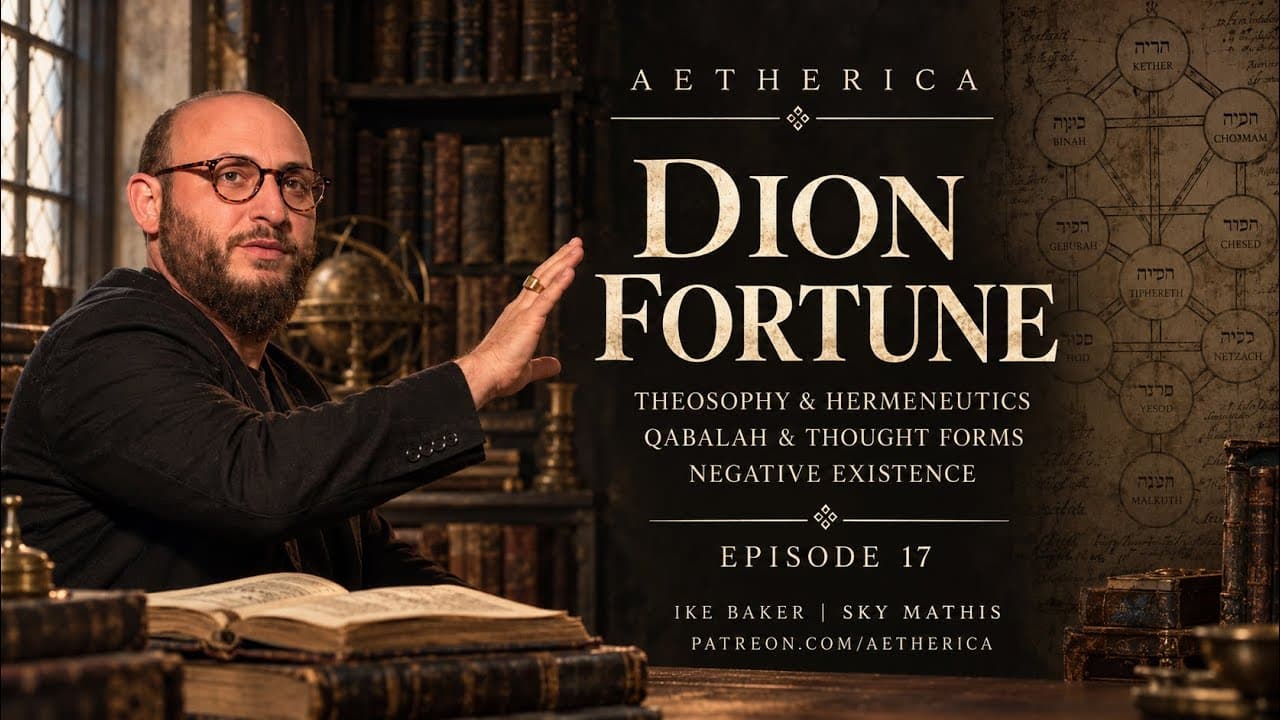 Episode 17Dion Fortune , Theosophy , Hermeneutics, Qabalah, thought Forms, Negative Existence #17Lands on Three Veils of Negative Existence Listen from 42:541 min chapter
Above Kether, the One, stand the three veils of negative existence: Ain, nothing; Ain Soph, limitless nothing; Ain Soph Aur, limitless light. Kether itself is not negative, and the creative ground of all things, it is observed, is called light in every tradition. The speaker takes the term from the Zohar but argues that the doctrine is Neoplatonic, taught by Plotinus before it appears in Judaism, and that it entered Kabbalah through Hellenised Judaism.
Sit with this
Above the highest point of the Tree stand veils that name only nothing and limitless light. What can a symbol do when what it points to has no form?
Station VIRead· Kept
Read the Tree as a glyph
Read alongside
The Mystical Qabalah
Dion Fortune
Fortune's study of the Tree of Life as a composite symbol of the cosmos and of the soul, and the source of the line on symbols and tools with which this route began. In the archive a host says it still holds for him fifteen years after he first read it, and names it, with The Kybalion, as one of the two books he recommends to every incoming initiate.
Sit with this
Read the opening chapters slowly and list every symbol Fortune names. Which of them have you already met on this route?
End of the route · its last question goes with you