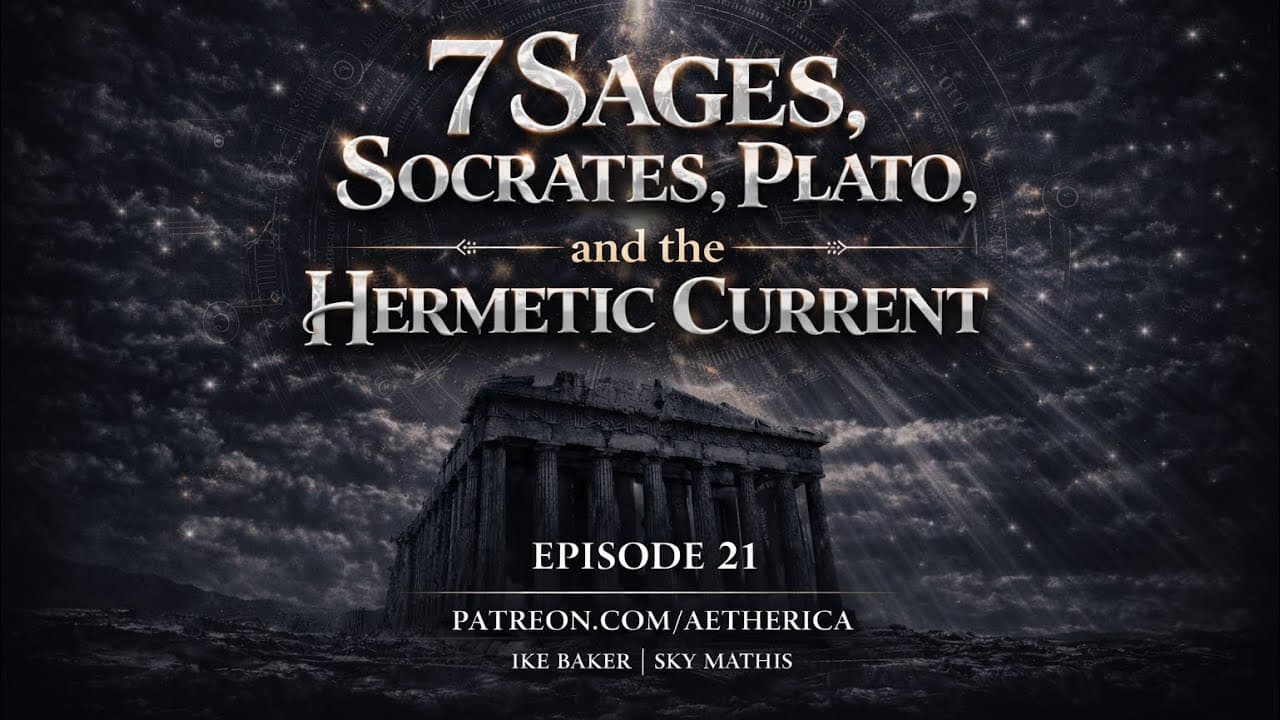
From there, we turn to Thales and the Seven Sages of Greece, asking what it meant to be a sage in the ancient world. The discussion explores wisdom, divine prompting, sacred law, and the idea that civilization itself may have depended on rare human beings who embodied a level of insight far beyond the ordinary.
We then move into Socrates—his daimon, his understanding of conscience and divine guidance, his philosophical mission, and why the famous phrase “I know that I know nothing” is often badly misunderstood. Along the way, we examine Socrates as a spiritually guided figure whose life was shaped not merely by intellect, but by obedience to an inner divine prompting.
The heart of the episode focuses on Plato: his moral seriousness, his theory of ideals, his religious and metaphysical vision, and his insistence that truth, goodness, and inquiry are real and worth striving for. We discuss Plato not just as a philosopher, but as a revealer of spiritual architecture—someone whose thought established a lasting framework for ethics, metaphysics, and the contemplative life.
The episode then enters the question of Hermes Trismegistus:
Who was Hermes?
Was Hermes a historical person, a symbolic title, a priestly lineage, or a literary authority?
Did Plato learn from Hermes, or was Hermetic philosophy itself shaped by Plato?